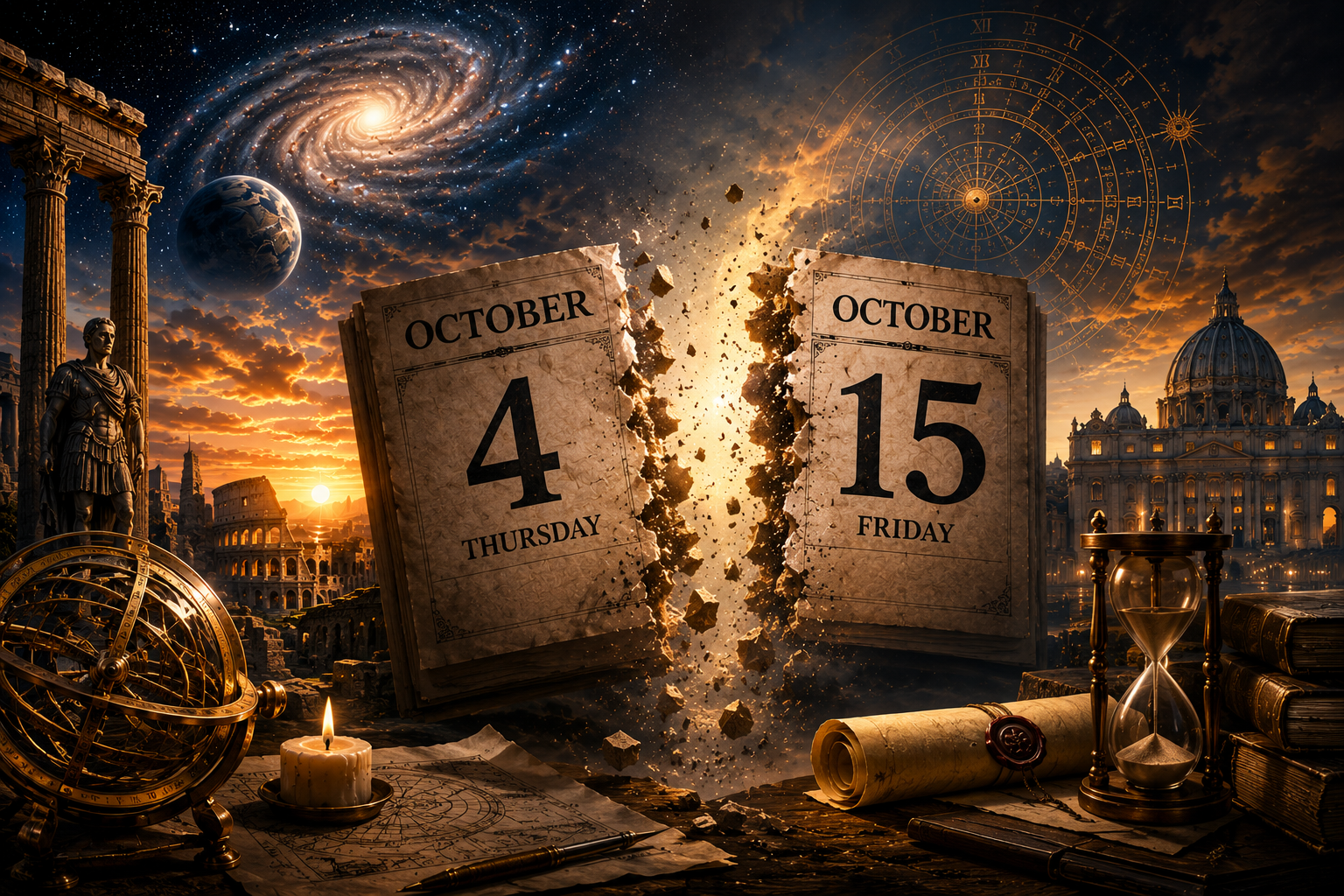
There was no October 5, 1582.
No October 6.
No October 7.
In parts of Europe, ten calendar dates simply vanished.
People went to sleep on October 4 and woke up on October 15.
The Earth still turned.
The sun still rose.
Time itself did not change.
Only humanity’s agreement about how to number it did.

That single correction reveals something most people never stop to consider.
The calendar is not nature.
It is one of humanity’s oldest engineered systems — a mathematical framework designed to keep civilization aligned with the motion of the Earth itself.
Most people trust the calendar without ever questioning it.
They glance at their phone. They see a date. They move on.
April 9 is April 9. Monday is Monday. January comes first. February has 28 days, except when it has 29. The week begins on Sunday for some people and Monday for others.
To most of us, these things feel permanent.
Fixed.
Natural.
They are not.
The calendar exists because without it, time becomes disorienting.
And like every system humanity has ever built, it required observation, correction, and the courage to confront drift.
That realization began for me with a watch.
Imagine waking tomorrow on an island.
No internet. No phone. No charger. No network. No clocks on walls. No atomic time servers silently correcting your devices.
Only a watch.
At first, that sounds sufficient.
A watch tells you the hour. It measures elapsed time. You could use it to estimate cooking intervals, observe the sun, time boiling water, and organize the day.

But eventually a deeper problem emerges.
How do you know what day it is?
How do you know whether this year has 365 days or 366?
How do you know when February gains an extra day?
How do you know whether your birthday falls on Tuesday this year or Sunday?
This is where most people discover something profound.
A watch measures intervals.
A calendar measures agreement.
A watch tells you how much time has passed.
A calendar tells you how humanity has chosen to label that passage.
And that agreement took thousands of years to refine.
Long before modern civilization, there was no universal calendar.
Different cultures built different systems.
The ancient Egyptians organized time around the flooding of the Nile.
Babylonians used lunar cycles.
Chinese dynasties developed lunisolar systems.
The Mayans constructed astonishingly sophisticated astronomical cycles.
Each civilization solved the same problem differently because each organized life around different priorities.
Then came Rome.
And Rome changed everything.
The Roman Empire was one of history’s most influential organizing forces.
Its roads connected continents.
Its legal systems shaped future governments.
Its language became the foundation of much of Europe.
Its administrative systems influenced civilization for centuries after the empire itself collapsed.
When Rome standardized something, that standard often outlived Rome.
Its calendar is one of the clearest examples.
But the early Roman calendar was chaotic.
And strangely enough, it was political.
In the Roman Republic, officials called pontifices controlled calendar adjustments.
They could add or remove days and months.
This was not trivial.
Controlling time meant controlling tax collection periods, legal deadlines, military service, and lengths of political office.
If extending the calendar benefited allies, it could be done.
If shortening it weakened opponents, that could happen too.
Imagine if today a government simply announced that March would now last forty-five days.
That was effectively possible.
Timekeeping was power.
And eventually the calendar drifted so badly from the seasons that reform became unavoidable.
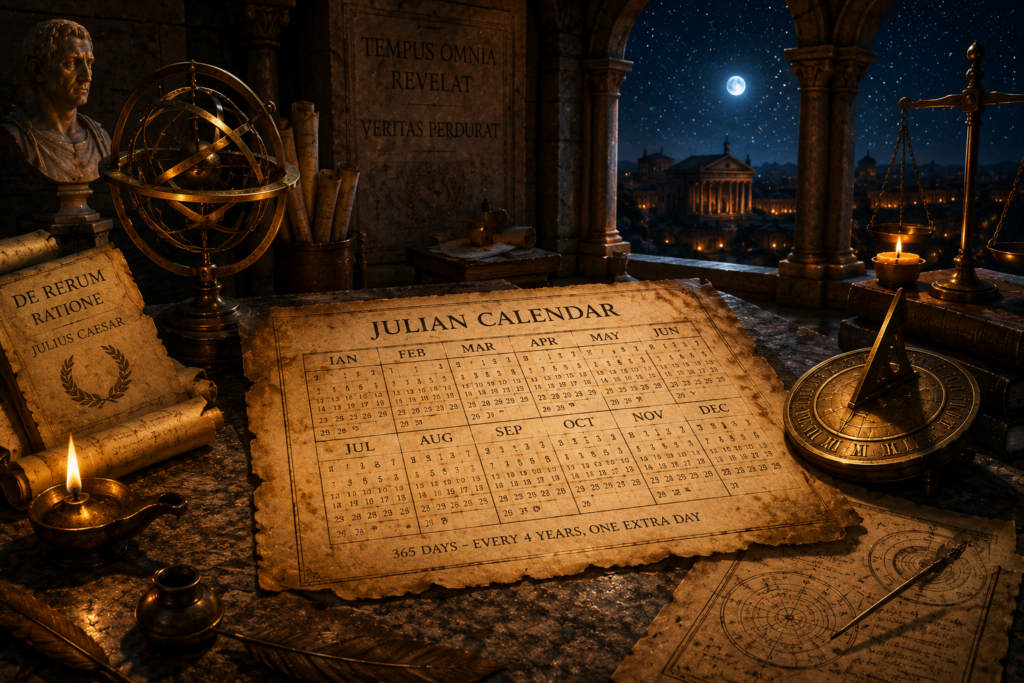
In 45 BC, Julius Caesar introduced the Julian calendar.
It imposed mathematical order.
The Julian system established 365 days in a normal year and one leap day every four years.
This created an average year of 365.25 days.
For its time, it was extraordinary.
It removed political manipulation and replaced it with rules.
Because Rome’s influence was so vast, this system spread across Europe and endured for more than 1,600 years.
But it contained a flaw.
The Earth does not orbit the sun in exactly 365.25 days.
A true solar year is approximately 365.2422 days.
That difference — about 11 minutes and 14 seconds per year — sounds insignificant.
It is not.
This also explains why a year is never as simple as it appears.
Most years contain 365 days.
Some contain 366.
And occasionally, history has produced stranger exceptions.
The most extreme was 46 BC, sometimes called The Year of Confusion.
When Julius Caesar reformed Rome’s collapsing calendar, it had drifted so badly from the seasons that a dramatic correction was required.
To realign it, additional months were inserted.
That year lasted approximately 445 days.
Imagine living through a year that stretched across what would feel like nearly fifteen modern months.
It is one of history’s clearest reminders that a year is not a naturally fixed number of days.
It is humanity’s best attempt to approximate an orbit that refuses to divide evenly.
Even leap years are evidence of this.
Earth completes its orbit in approximately 365.2422 days.
That fractional remainder — about 5 hours, 48 minutes, and 46 seconds — accumulates.
Every four years, enough excess time builds that we add February 29 to restore alignment.
Without that correction, the calendar would slowly drift away from the seasons.
The same truth appears everywhere in timekeeping:
small discrepancies become large distortions when ignored long enough.
Small errors compound.
After about 128 years, the Julian calendar drifted by one full day.
After more than 1,500 years, it had drifted by approximately ten days.
Humanity’s numbering system had drifted away from astronomical reality.
The calendar no longer aligned properly with the sky.
By the 1500s, the drift had become impossible to ignore.
One major reason was Easter, whose date depends on astronomical timing.
As the calendar drifted, Easter drifted with it.
So in 1582, Pope Gregory XIII introduced the Gregorian calendar.
The reform made two major corrections.
First, it removed the accumulated drift.
In adopting countries, Thursday, October 4, 1582 was followed by Friday, October 15, 1582.
Ten dates disappeared.
October 5 through October 14 never officially existed there.
Time itself did not vanish.
Only the labels changed.

Second, it refined leap-year rules.
A year is leap year if divisible by 4.
Except if divisible by 100.
Except if divisible by 400.
That is why 2000 was a leap year, 2100 will not be, and 2400 will be.
This is the algorithm still governing our calendar today.
Not all countries adopted the reform at once.
Catholic nations adopted it quickly.
Protestant nations resisted.
Great Britain and its colonies waited until 1752.
This created a remarkable historical reality.
The same physical day could be recorded under different dates in different countries.
Two nations could literally describe the same event using different calendar labels.
History briefly existed on competing timelines.
For centuries, Britain treated March 25 — known as Lady Day — as the beginning of the legal year.
This date commemorated the Annunciation and fell near the spring equinox, making it symbolically associated with renewal.
When Britain adopted the Gregorian calendar, it also moved New Year’s Day to January 1 to align with continental Europe.
This changed historical dates.
It is why George Washington appears to have two birthdays.
Originally recorded as February 11, 1731 under the old system, his birthday became February 22, 1732 under the new one.
The man did not change.
The framework around him did.

Even our language carries these ancient systems.
January was named for Janus, the Roman god of beginnings.
March for Mars.
May for Maia.
June for Juno.
July for Julius Caesar.
August for Augustus.
Then comes the strange part.
September means seven.
October means eight.
November means nine.
December means ten.
Why?
Because the Roman year originally began in March.
The names are fossils from an older calendar.
The days of the week preserve Roman and Norse influence.
Tuesday for Tiw.
Wednesday for Woden.
Thursday for Thor.
Friday for Frigg.
Even the order of the week is convention.
European calendars often begin Monday due to international business standards.
American calendars often begin Sunday due to Christian tradition.
Neither is inherently more correct.
Both are agreements.
Watches reveal this same lesson.
A few seconds of daily drift sounds harmless.
It is not.
Small errors compound.
A network-connected Apple Watch may remain essentially perfect because it is constantly corrected.
A radio-controlled G-Shock borrows precision from atomic broadcast towers.
A satellite-synchronized Citizen borrows precision from orbiting references.
A high-accuracy quartz watch may take decades or even centuries to drift significantly.
A mechanical Rolex might drift ten minutes in roughly 300 days.
A typical NH35 automatic might do it in about a month.
Each reveals something different about timekeeping.
A network-connected device borrows precision from civilization.
A radio watch borrows it from infrastructure.
A satellite watch borrows it from orbiting atomic references.
A mechanical watch creates it on its own.
That distinction matters.
The Julian calendar drifted by only eleven minutes each year.
That sounds trivial.
Yet over centuries, those minutes became days.
Enough drift accumulated that humanity had to delete ten calendar dates to restore alignment.
That is the deeper truth hidden inside every clock, every calendar, and every second hand.
Small errors are never truly small.
Left uncorrected, they compound.
Every system drifts.
Every framework accumulates error.
Truth demands recalibration.
The world does not remain aligned by accident.
Someone must notice the drift.
Someone must make the correction.
Time does not organize itself.
We do.