There is a stage in life when the self sits at the center of everything.
We seek achievement.
We seek recognition.
We seek influence.
We imagine that if we can become important enough, successful enough, admired enough, then our lives will finally possess the meaning we seek.
Many ambitions are born from this desire.
To be known.
To be respected.
To matter.
There is nothing unusual about this. Nearly every person begins there. The young entrepreneur wants to build a company. The aspiring politician wants to win an election. The student wants to graduate at the top of the class. The professional wants the promotion.
The focus is understandable.
The focus is the self.
Yet life has a way of disrupting this pursuit.
The heroes we admire reveal their flaws.
The institutions we trust reveal their weaknesses.
The achievements we pursue reveal their limitations.
One by one, the assumptions begin to crack.
The title does not provide lasting fulfillment.
The applause fades.
The recognition proves temporary.
And eventually a different question emerges.
Not:
“How can I become important?”
But:
“What is important?”
This question changes everything.
The person who seeks importance asks how to rise.
The person who seeks truth asks what deserves to be served.
The difference appears small, but it transforms the direction of a life.
When the self is at the center, every setback feels personal. Every criticism feels like an attack. Every failure becomes a threat to identity.
But when a mission takes the center, the self becomes secondary.
The question is no longer whether I receive credit.
The question is whether the work advances.
The question is whether the truth is spoken.
The question is whether the mission moves forward.
This is why some people endure extraordinary resistance without surrendering.
Their strength does not come from believing they are extraordinary.
Their strength comes from believing the mission is.
The person who seeks fame loses motivation when the applause disappears.
The person who serves a mission continues because the mission remains.
History often remembers the great leaders, but their lasting influence rarely began with a desire for greatness. More often it began with conviction.
A conviction that something was wrong.
A conviction that something could be improved.
A conviction that an important truth was being ignored.
Conviction is powerful because it creates action.
Yet conviction alone is not enough.
History is filled with people who possessed deep conviction and were completely mistaken.
For this reason conviction requires a companion.
Clarity.
The willingness to question oneself.
The willingness to examine evidence.
The willingness to pursue truth rather than merely defend a position.
Without clarity, conviction becomes fanaticism.
Without conviction, clarity becomes paralysis.
Together they create the conditions for meaningful action.
This realization changes how one views leadership.
Leadership is not the pursuit of power.
Leadership is the willingness to accept responsibility for advancing something greater than oneself.
A person may never hold office.
A person may never become famous.
A person may never receive recognition.
And yet that person may still live a life of profound significance.
Because significance is not measured by how many people know your name.
It is measured by what you chose to serve.
The journey from self to mission is not the abandonment of ambition.
It is the transformation of ambition.
No longer asking:
“How high can I climb?”
But asking:
“What is worthy of my effort?”
That is the question that reshapes a life.
And once it is answered, many of the old pursuits lose their power.
For the purpose of a life is not to become important.
The purpose of a life is to discover what is important and devote oneself to it.
Something a child might collect and place in a jar.
Something a traveler might carry home as a souvenir.
Yet this shell helped build civilizations.
Not because of what it was.
Because of what it became.
For most of human history, people did not use money.
A fisherman caught fish.
A farmer grew grain.
A blacksmith forged tools.
A builder raised homes.
Trade occurred directly.
Fish for grain.
Grain for tools.
Tools for labor.
This system worked when communities were small and needs were simple.
But it suffered from a problem.
Economists would later call it the “double coincidence of wants.”
If the fisherman wanted grain, the farmer also needed to want fish.
At the same moment.
In the same place.
Trade became increasingly difficult as societies grew larger.
Humanity needed a better way to keep score.
Imagine spending an entire week building a neighbor’s home.
You have contributed something valuable.
But what if you do not need anything today?
How does society remember your contribution until next month?
Or next year?
The answer was a claim.
A portable reminder that value had already been created.
A way to carry yesterday’s labor into tomorrow.
Different civilizations experimented with different claims.
Salt.
Livestock.
Tea.
Tobacco.
Metal.
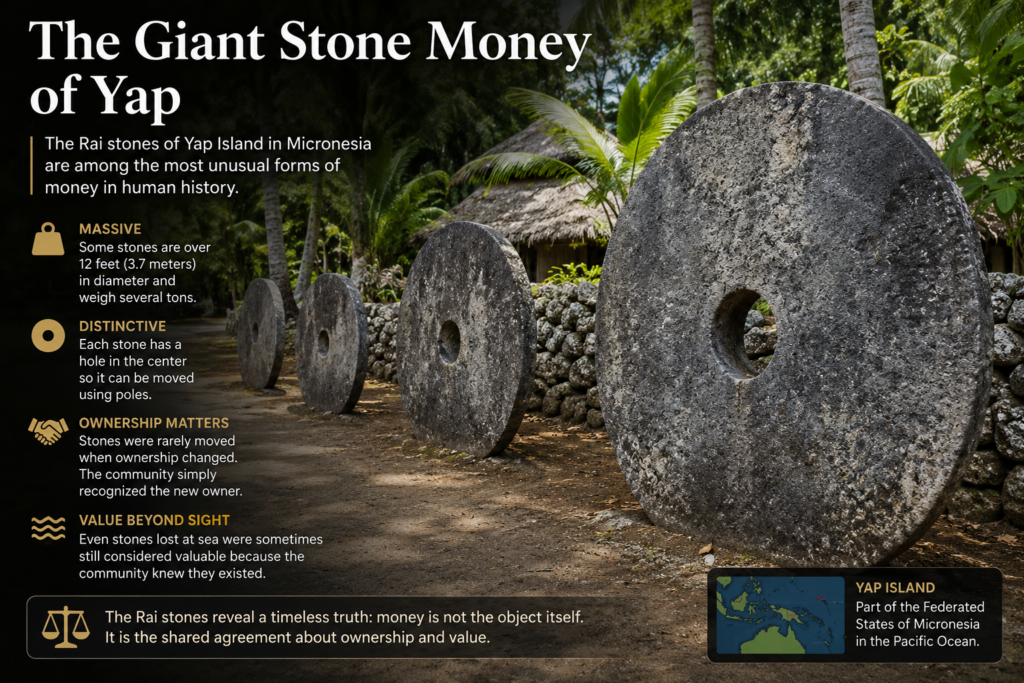
Even giant stone disks on remote Pacific islands.
But one of the most successful forms of early money came from an unlikely source.
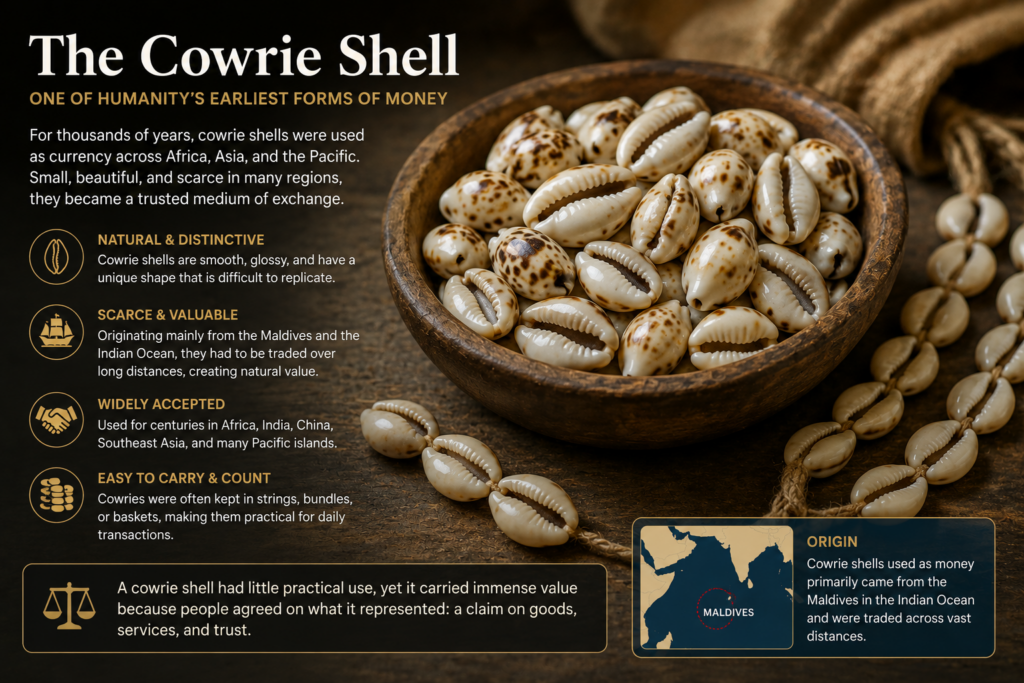
The cowrie shell.
Cowrie shells are small, glossy marine shells primarily found around the Maldives and parts of the Indian Ocean. They are attractive, durable, difficult to counterfeit, and remarkably consistent in size.
Most importantly, they were scarce in the places where they were used.
That detail matters.
In some parts of Africa, cowrie shells became money for centuries.
A villager could not simply walk to the nearest beach and gather unlimited wealth.
The shells had traveled thousands of miles through trade networks.
Acquiring them required effort, exchange, or access to commerce.
The shell’s value came not from its usefulness but from its scarcity.
This reveals one of the first truths about money.
A claim only works when false claims are difficult to create.
Imagine a society using ordinary pebbles as money.
Anyone could gather thousands from a riverbed.
The pebbles would no longer represent contribution.
They would represent nothing.
The system would collapse.
The same principle would later govern silver.
Gold.
Paper currency.
Bank accounts.
And even digital money.
Every monetary system ultimately faces the same challenge:
How do we record legitimate claims while preventing illegitimate ones?
The forms change.
The problem does not.
For centuries cowrie shells helped answer that question.
But eventually another form of money emerged that would connect the entire world.
Silver.
And no nation embraced silver more completely than Spain.
In 1492, Christopher Columbus sailed west under the Spanish crown.
Within decades Spain controlled vast territories throughout the Americas.
Then came discoveries that would reshape global history.
Silver.
Enormous quantities of it.
Some of the richest deposits on Earth were found at places such as Potosí, located in modern Bolivia, and Zacatecas in Mexico.
The scale was staggering.
Mountains were transformed into money.
Silver flowed across oceans.
Spanish treasure fleets carried wealth back to Europe in quantities previously unimaginable.
The metal was minted into coins known as reales.
Among them was one particular coin that became famous throughout the world.
The Spanish dollar.
More commonly known as the Piece of Eight.
A Piece of Eight was a large silver coin worth eight reales.
Unlike many currencies of the period, its silver content was trusted and relatively consistent.
Merchants valued predictability.
Trust spread.
Soon Spanish dollars circulated throughout Europe, the Americas, Africa, and Asia.
Chinese merchants accepted them.
European merchants accepted them.
Colonial merchants accepted them.
The coin became the world’s first truly global currency.
Long before the internet connected humanity digitally, the Piece of Eight connected humanity economically.
Its influence survives to this day.
When the United States gained independence, Spanish dollars remained common throughout the colonies.
Americans already trusted them.
The United States eventually adopted the dollar as its own currency.
Even the symbol “$” may trace part of its heritage to Spain.
One theory points to the Pillars of Hercules, the two rock formations flanking the entrance to the Mediterranean near Gibraltar. Spanish coins often depicted these pillars wrapped with a banner bearing the imperial motto “Plus Ultra” — “Further Beyond.”
Over time, some historians believe these markings evolved into forms resembling the modern dollar sign.
Another theory traces the symbol to the abbreviation “PS” for peso, gradually merged into a single character.
The exact origin remains debated.
What is not debated is Spain’s influence.
The modern dollar carries traces of the Spanish world.
For a time Spain appeared unstoppable.
Silver poured into the empire.
Treasure fleets crossed oceans.
Kings spent fortunes.
Wars were financed.
Palaces were built.
Spain possessed what every nation seemed to desire.
Money.
Yet beneath the surface, something dangerous was happening.
Spain was accumulating claims.
Others were building productive capacity.
The Dutch expanded trade networks.
The English expanded manufacturing.
Shipyards grew.
Markets matured.
Industries developed.
Spain increasingly purchased what others produced.
Why build when silver arrives by the shipload?
Why manufacture when treasure can buy imports?
The silver created prosperity.
It also weakened incentives.
Slowly, almost invisibly, Spain began mistaking claims for wealth.
But claims are not wealth.
Claims are permissions.
Wealth is the ability to create.
This distinction matters.
A silver coin allows you to obtain bread.
It does not bake bread.
A dollar allows you to buy a house.
It does not build a house.
A stock certificate allows you to claim ownership.
It does not create a business.
The claim and the thing being claimed are related.
They are not the same.
Spain learned this lesson painfully.
When silver production slowed and military costs mounted, the empire discovered that claims alone could not sustain prosperity.
The silver had made Spain rich.
But it had not made Spain productive.
That lesson echoes through history.
And it remains just as relevant today as it was five hundred years ago.
Spain’s mistake did not end with Spain.
The names changed.
The technologies changed.
The currencies changed.
The underlying temptation remained.
To mistake claims for production.
To mistake the scorecard for the game.
To mistake ownership for creation.
Every generation rediscovers this lesson.
Some learn it through silver.
Others through real estate.
Others through stock markets.
Others through debt.
The forms change.
The principle does not.
To understand why, we must look beneath the surface of the modern economy.
Most people think of the economy as money.
They see paychecks.
Prices.
Bank accounts.
Credit cards.
Mortgages.
Stocks.
But money is merely the visible layer.
The economy itself resembles a structure built upon many layers stacked atop one another.
The higher layers become increasingly visible.
The lower layers become increasingly important.
And yet most people spend their lives looking upward rather than downward.
The foundation of everything is the Productive Layer.
This is where value enters the system.
Farmers grow food.
Factories manufacture products.
Energy companies generate power.
Builders construct homes.
Software developers create tools.
Retailers connect products with customers.
This layer transforms raw materials, knowledge, labor, and resources into something more valuable than before.
Without production, nothing else exists.
A society cannot consume what it does not create.
Every dollar, every stock, every loan, every pension, every government program ultimately rests upon productive activity occurring somewhere beneath it.
Above production lies the Labor Layer.
This is where most people live.
Workers exchange time, expertise, judgment, creativity, and effort for claims.
A teacher teaches.
A mechanic repairs.
A nurse cares for patients.
A programmer writes code.
A salesperson serves customers.
Labor is honorable.
Labor is necessary.
Without labor, production collapses.
Yet labor contains a limitation.
Time.
A person has only twenty-four hours in a day.
No matter how talented or disciplined, labor eventually encounters a ceiling.
This creates one of the great frustrations of modern life.
Many people work extremely hard.
Yet they discover that effort alone does not determine outcomes.
Something else is operating.
The next layer explains why.
Above labor sits the Leverage Layer.
Leverage is the ability to multiply effort.
A man digging with a shovel can move earth.
A man operating an excavator can move a hillside.
The difference is not effort.
The difference is leverage.
Technology is leverage.
Machinery is leverage.
Software is leverage.
Credit is leverage.
A small business owner may borrow money to purchase equipment that dramatically increases production.
An entrepreneur may build software used by millions.
A factory owner may employ machinery that accomplishes the work of hundreds.
Leverage allows one person’s effort to influence far more than one person’s output.
Throughout history, those who understood leverage often accumulated more claims than those who relied solely upon labor.
Not because they worked harder.
Because they multiplied their work.
Above leverage lies the Payment Layer.
This layer moves claims.
Banks.
Payment processors.
Settlement networks.
Clearinghouses.
Credit card systems.
ACH networks.
Wire transfers.
The Payment Layer does not create value.
It creates movement.
Its purpose is coordination.
The modern economy could not function without it.
Imagine a world where every transaction required physically carrying gold from one town to another.
Commerce would slow to a crawl.
The Payment Layer allows claims to travel instantly.
It is the circulatory system of the economy.
Above payments sits the Asset Layer.
This is where the rules begin to change.
Assets are productive things that continue generating claims after the original labor has ended.
Businesses.
Real estate.
Patents.
Royalties.
Intellectual property.
Stocks.
A worker earns claims.
An asset produces claims.
This distinction explains much of modern wealth.
Consider two individuals.
The first earns one hundred thousand dollars per year through labor.
The second owns a business that generates one hundred thousand dollars per year.
Both receive identical claims.
Yet their situations are profoundly different.
The worker must continue working.
The business continues operating.
One depends upon time.
The other depends upon ownership.
Ownership separates claims from direct labor.
This is why the largest fortunes rarely emerge from wages alone.
Not because labor lacks value.
Because labor is constrained by time.
Assets are not.
Above the Asset Layer sits the Subsidized Layer.
Governments influence the economy by directing claims toward specific activities.
Defense contracts.
Public universities.
Healthcare programs.
Agricultural subsidies.
Infrastructure projects.
The Subsidized Layer exists because societies often pursue goals beyond pure market efficiency.
National defense.
Public education.
Scientific research.
Social stability.
Whether these programs succeed or fail is a separate question.
What matters is understanding that government spending influences where claims flow.
Above subsidies lies the Rent-Seeking Layer.
This layer earns claims by controlling access.
Historically this might have meant a bridge toll.
Today it may mean transaction fees, licensing rights, platform control, or regulatory advantages.
Some forms of rent-seeking provide genuine value through coordination and convenience.
Others simply extract value from activity created elsewhere.
The distinction is often debated.
The existence of the layer is not.
Above this sits the Shadow Layer.
Most people never see it.
Yet trillions of dollars move through it.
Private credit.
Institutional financing.
Repo markets.
Investment structures operating outside traditional banking systems.
The Shadow Layer is not necessarily illegal.
Nor is it necessarily dangerous.
It is simply less visible.
Like roots beneath a tree, much of its activity occurs outside public attention.
At the top sits the Policy Layer.
Central banks.
Governments.
Regulators.
Legislatures.
This layer creates rules that influence every layer beneath it.
Interest rates.
Tax policy.
Monetary policy.
Regulation.
Trade policy.
A single policy decision can redirect trillions of dollars worth of claims.
Most people underestimate this layer because it often appears distant.
Yet it influences nearly every economic outcome below it.
The economy therefore resembles a structure.
Production creates value.
Labor supplies effort.
Leverage multiplies effort.
Payments move claims.
Assets compound claims.
Subsidies redirect claims.
Rent-seeking extracts claims.
Shadow systems expand claims.
Policy governs claims.
Once this structure becomes visible, a question naturally emerges.
Why do some people accumulate dramatically more claims than others?
Many assume the answer is hard work.
Hard work matters.
But the economy rewards more than effort.
It rewards scarcity.
Leverage.
Ownership.
Coordination.
Innovation.
A worker may create value through labor.
An entrepreneur may create a system that enables thousands of workers to create value.
An inventor may create a tool that increases productivity for millions.
An investor may allocate capital toward productive activity.
Each participates in different layers.
Each accumulates claims differently.
This explains why labor alone rarely produces extraordinary wealth.
The laborer sells hours.
The owner controls assets.
The inventor creates leverage.
The organizer coordinates systems.
The difference is not moral worth.
The difference is economic position.
And here the lesson of Spain returns.
A society can become obsessed with claims.
It can celebrate rising asset prices.
Expanding debt.
Financial engineering.
Paper wealth.
But eventually every claim must rest upon production.
Someone must still grow food.
Generate energy.
Build homes.
Manufacture goods.
Write software.
Repair machines.
Move products.
Create value.
The further claims drift from production, the more fragile the system becomes.
The stronger the connection between claims and creation, the more durable prosperity becomes.
This is the lesson of the shell.
This is the lesson of Spain.
And it may be one of the most important economic truths of all:
A civilization does not become wealthy because it possesses claims.
A civilization becomes wealthy because it continues creating the value those claims represent.
Once you understand claims, you begin seeing them everywhere.
Not just in money.
In life.
The shell was a claim.
The silver coin was a claim.
The dollar bill is a claim.
But money is not the only scorekeeping system humanity has invented.
We surround ourselves with claims.
Titles are claims.
Degrees are claims.
Awards are claims.
Followers are claims.
Reputation is a claim.
Even authority itself is often a claim.
Each represents something beneath it.
Or at least it is supposed to.
A diploma is a claim of knowledge.
A job title is a claim of responsibility.
A certification is a claim of competence.
A medal is a claim of achievement.
A social media following is a claim of influence.
The claim is not the thing itself.
The claim is evidence of the thing.
Or at least it begins that way.
This reveals a pattern that appears throughout history.
Human beings create systems to measure reality.
Then, over time, many begin pursuing the measurement instead of the reality.
Students chase grades rather than learning.
Companies chase quarterly earnings rather than building enduring value.
Politicians chase polls rather than solving problems.
Influencers chase followers rather than influence.
Employees chase titles rather than capability.
Nations chase financial claims rather than productive strength.
The scorecard slowly becomes more important than the game.
This is one of the recurring traps of civilization.
The measurement was created to serve reality.
Eventually reality begins serving the measurement.
The map replaces the territory.
The shell replaces the labor.
The dollar replaces the value.
The title replaces the competence.
The symptom is easy to recognize.
Whenever a system becomes obsessed with appearances, the underlying reality begins to weaken.
Consider a company.
At first, the company exists to serve customers.
Products improve.
Employees solve problems.
Value is created.
Growth follows.
Then something changes.
Management becomes obsessed with metrics.
The metrics originally existed to measure performance.
Now performance exists to improve metrics.
The purpose has inverted.
The same thing happens to people.
A young person may begin life seeking mastery.
To learn.
To build.
To understand.
Then slowly another goal emerges.
Recognition.
Status.
Prestige.
Validation.
The claim begins replacing the thing being claimed.
The danger is not that claims are useless.
Claims are essential.
Without them, large societies cannot function.
The danger is forgetting what they represent.
This is why some people arrive at the top of a ladder and discover they are unhappy.
The title was acquired.
The capability was neglected.
The wealth was accumulated.
The purpose was forgotten.
The recognition was earned.
The fulfillment never arrived.
They spent years collecting claims.
They spent little time building the reality beneath them.
The same principle applies to nations.
A nation can accumulate debt.
Assets.
Financial wealth.
Rising stock prices.
Expanding claims.
Yet if fewer people build, invent, repair, create, teach, and solve problems, the foundation weakens.
For a time the upper layers may continue growing.
Claims often expand faster than reality.
But eventually reality demands reconciliation.
Reality always does.
This is one of the reasons truth matters.
Truth is reality whether acknowledged or not.
A business may ignore reality.
Reality remains.
A government may ignore reality.
Reality remains.
An individual may ignore reality.
Reality remains.
One can postpone the bill.
One cannot eliminate it.
This leads to another uncomfortable observation.
Many of the most important things in life resist measurement.
Character.
Wisdom.
Integrity.
Judgment.
Love.
Purpose.
Resilience.
None fit neatly onto a balance sheet.
None can be fully expressed through a score.
Yet they often determine outcomes more than the things that can be measured.
The modern world tends to reward visibility.
Truth often resides in what remains invisible.
The market value of a company can be measured instantly.
The quality of its culture cannot.
A salary can be measured precisely.
The quality of a marriage cannot.
A follower count can be measured.
Wisdom cannot.
This creates a permanent temptation.
To optimize what can be counted while neglecting what counts.
The temptation appears in every age.
The form merely changes.
The shell became the coin.
The coin became the dollar.
The dollar became a digital entry.
The principle remained.
Human beings are drawn toward symbols.
Truth requires looking beneath them.
This does not mean claims are unimportant.
They matter greatly.
Money matters.
Titles matter.
Credentials matter.
Reputation matters.
The mistake is treating them as the destination.
They are indicators.
Not the thing itself.
A compass is valuable.
Only a fool mistakes it for the journey.
And perhaps that is one of the central lessons hidden beneath the shell.
The purpose of a claim is not to become the object of devotion.
Its purpose is to point toward reality.
When claims and reality remain connected, individuals flourish.
Organizations flourish.
Nations flourish.
When claims drift too far from reality, confusion follows.
Then instability.
Then decline.
The challenge for every generation is therefore the same.
To see the symbol.
To understand the system.
And then to remember what the system was built to measure in the first place.
That is the work of truth.
That is the path toward clarity.
And once clarity is achieved, conviction becomes possible.
In parts of Europe, ten calendar dates simply vanished.
People went to sleep on October 4 and woke up on October 15.
The Earth still turned.
The sun still rose.
Time itself did not change.
Only humanity’s agreement about how to number it did.
That single correction reveals something most people never stop to consider.
The calendar is not nature.
It is one of humanity’s oldest engineered systems — a mathematical framework designed to keep civilization aligned with the motion of the Earth itself.
Most people trust the calendar without ever questioning it.
They glance at their phone. They see a date. They move on.
April 9 is April 9. Monday is Monday. January comes first. February has 28 days, except when it has 29. The week begins on Sunday for some people and Monday for others.
To most of us, these things feel permanent.
Fixed.
Natural.
They are not.
The calendar exists because without it, time becomes disorienting.
And like every system humanity has ever built, it required observation, correction, and the courage to confront drift.
That realization began for me with a watch.
Imagine waking tomorrow on an island.
No internet. No phone. No charger. No network. No clocks on walls. No atomic time servers silently correcting your devices.
Only a watch.
At first, that sounds sufficient.
A watch tells you the hour. It measures elapsed time. You could use it to estimate cooking intervals, observe the sun, time boiling water, and organize the day.
But eventually a deeper problem emerges.
How do you know what day it is?
How do you know whether this year has 365 days or 366?
How do you know when February gains an extra day?
How do you know whether your birthday falls on Tuesday this year or Sunday?
This is where most people discover something profound.
A watch measures intervals.
A calendar measures agreement.
A watch tells you how much time has passed.
A calendar tells you how humanity has chosen to label that passage.
And that agreement took thousands of years to refine.
Long before modern civilization, there was no universal calendar.
Different cultures built different systems.
The ancient Egyptians organized time around the flooding of the Nile.
Babylonians used lunar cycles.
Chinese dynasties developed lunisolar systems.
The Mayans constructed astonishingly sophisticated astronomical cycles.
Each civilization solved the same problem differently because each organized life around different priorities.
Then came Rome.
And Rome changed everything.
The Roman Empire was one of history’s most influential organizing forces.
Its roads connected continents.
Its legal systems shaped future governments.
Its language became the foundation of much of Europe.
Its administrative systems influenced civilization for centuries after the empire itself collapsed.
When Rome standardized something, that standard often outlived Rome.
Its calendar is one of the clearest examples.
But the early Roman calendar was chaotic.
And strangely enough, it was political.
In the Roman Republic, officials called pontifices controlled calendar adjustments.
They could add or remove days and months.
This was not trivial.
Controlling time meant controlling tax collection periods, legal deadlines, military service, and lengths of political office.
If extending the calendar benefited allies, it could be done.
If shortening it weakened opponents, that could happen too.
Imagine if today a government simply announced that March would now last forty-five days.
That was effectively possible.
Timekeeping was power.
And eventually the calendar drifted so badly from the seasons that reform became unavoidable.
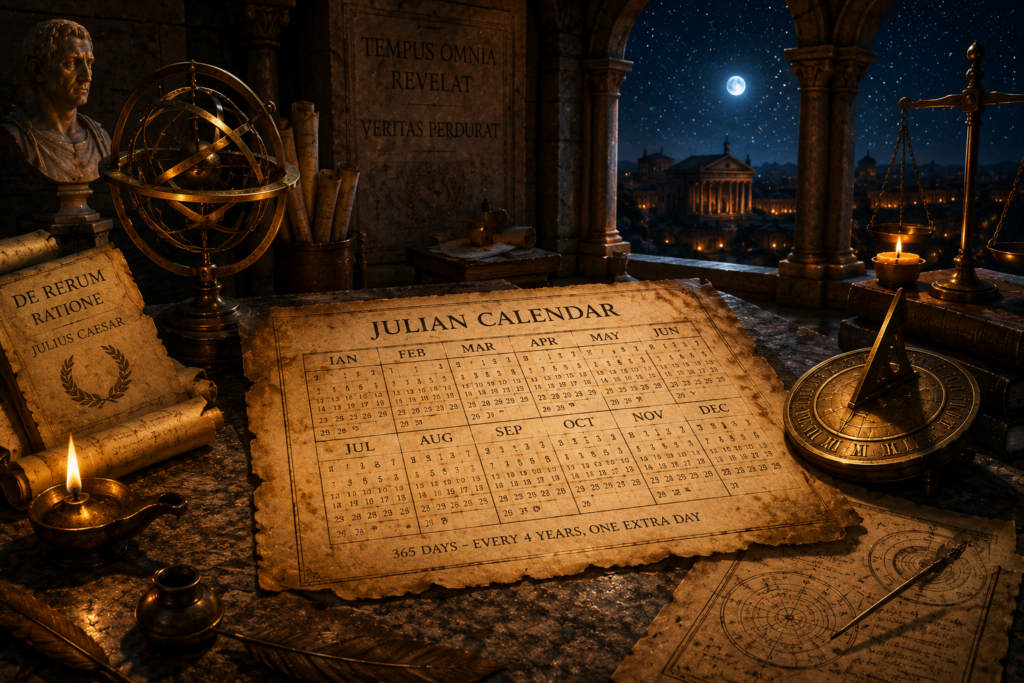
In 45 BC, Julius Caesar introduced the Julian calendar.
It imposed mathematical order.
The Julian system established 365 days in a normal year and one leap day every four years.
This created an average year of 365.25 days.
For its time, it was extraordinary.
It removed political manipulation and replaced it with rules.
Because Rome’s influence was so vast, this system spread across Europe and endured for more than 1,600 years.
But it contained a flaw.
The Earth does not orbit the sun in exactly 365.25 days.
A true solar year is approximately 365.2422 days.
That difference — about 11 minutes and 14 seconds per year — sounds insignificant.
It is not.
This also explains why a year is never as simple as it appears.
Most years contain 365 days.
Some contain 366.
And occasionally, history has produced stranger exceptions.
The most extreme was 46 BC, sometimes called The Year of Confusion.
When Julius Caesar reformed Rome’s collapsing calendar, it had drifted so badly from the seasons that a dramatic correction was required.
To realign it, additional months were inserted.
That year lasted approximately 445 days.
Imagine living through a year that stretched across what would feel like nearly fifteen modern months.
It is one of history’s clearest reminders that a year is not a naturally fixed number of days.
It is humanity’s best attempt to approximate an orbit that refuses to divide evenly.
Even leap years are evidence of this.
Earth completes its orbit in approximately 365.2422 days.
That fractional remainder — about 5 hours, 48 minutes, and 46 seconds — accumulates.
Every four years, enough excess time builds that we add February 29 to restore alignment.
Without that correction, the calendar would slowly drift away from the seasons.
The same truth appears everywhere in timekeeping:
small discrepancies become large distortions when ignored long enough.
Small errors compound.
After about 128 years, the Julian calendar drifted by one full day.
After more than 1,500 years, it had drifted by approximately ten days.
Humanity’s numbering system had drifted away from astronomical reality.
The calendar no longer aligned properly with the sky.
By the 1500s, the drift had become impossible to ignore.
One major reason was Easter, whose date depends on astronomical timing.
As the calendar drifted, Easter drifted with it.
So in 1582, Pope Gregory XIII introduced the Gregorian calendar.
The reform made two major corrections.
First, it removed the accumulated drift.
In adopting countries, Thursday, October 4, 1582 was followed by Friday, October 15, 1582.
Ten dates disappeared.
October 5 through October 14 never officially existed there.
Time itself did not vanish.
Only the labels changed.
Second, it refined leap-year rules.
A year is leap year if divisible by 4.
Except if divisible by 100.
Except if divisible by 400.
That is why 2000 was a leap year, 2100 will not be, and 2400 will be.
This is the algorithm still governing our calendar today.
Not all countries adopted the reform at once.
Catholic nations adopted it quickly.
Protestant nations resisted.
Great Britain and its colonies waited until 1752.
This created a remarkable historical reality.
The same physical day could be recorded under different dates in different countries.
Two nations could literally describe the same event using different calendar labels.
History briefly existed on competing timelines.
For centuries, Britain treated March 25 — known as Lady Day — as the beginning of the legal year.
This date commemorated the Annunciation and fell near the spring equinox, making it symbolically associated with renewal.
When Britain adopted the Gregorian calendar, it also moved New Year’s Day to January 1 to align with continental Europe.
This changed historical dates.
It is why George Washington appears to have two birthdays.
Originally recorded as February 11, 1731 under the old system, his birthday became February 22, 1732 under the new one.
The man did not change.
The framework around him did.
Even our language carries these ancient systems.
January was named for Janus, the Roman god of beginnings.
March for Mars.
May for Maia.
June for Juno.
July for Julius Caesar.
August for Augustus.
Then comes the strange part.
September means seven.
October means eight.
November means nine.
December means ten.
Why?
Because the Roman year originally began in March.
The names are fossils from an older calendar.
The days of the week preserve Roman and Norse influence.
Tuesday for Tiw.
Wednesday for Woden.
Thursday for Thor.
Friday for Frigg.
Even the order of the week is convention.
European calendars often begin Monday due to international business standards.
American calendars often begin Sunday due to Christian tradition.
Neither is inherently more correct.
Both are agreements.
Watches reveal this same lesson.
A few seconds of daily drift sounds harmless.
It is not.
Small errors compound.
A network-connected Apple Watch may remain essentially perfect because it is constantly corrected.
A radio-controlled G-Shock borrows precision from atomic broadcast towers.
A satellite-synchronized Citizen borrows precision from orbiting references.
A high-accuracy quartz watch may take decades or even centuries to drift significantly.
A mechanical Rolex might drift ten minutes in roughly 300 days.
A typical NH35 automatic might do it in about a month.
Each reveals something different about timekeeping.
A network-connected device borrows precision from civilization.
A radio watch borrows it from infrastructure.
A satellite watch borrows it from orbiting atomic references.
A mechanical watch creates it on its own.
That distinction matters.
The Julian calendar drifted by only eleven minutes each year.
That sounds trivial.
Yet over centuries, those minutes became days.
Enough drift accumulated that humanity had to delete ten calendar dates to restore alignment.
That is the deeper truth hidden inside every clock, every calendar, and every second hand.
In today’s society, loans have become an integral part of many individuals’ lives, providing the means to acquire essential assets and pursue higher education. However, there exists a stark disparity in the scrutiny applied to different loan types. Home and auto loans tend to be meticulously scrutinized based on borrowers’ ability to repay the loan or provide adequate collateral. On the other hand, student loans often overlook critical considerations such as the probability of career prospects and the burden placed on young individuals. This essay aims to shed light on this disparity and examine the institutionalized coercion of young people to take on student debt, which lacks the same level of scrutiny found in other loan types.
Scrutiny of Ability to Repay and Collateral: When individuals seek home or auto loans, lending institutions rigorously assess their financial capability to repay the loan and often require collateral to secure the loan amount. Borrowers are subject to income verification, credit checks, and analysis of their financial history. Lenders strive to minimize the risk of default and ensure the tangible assets being purchased can serve as collateral if needed. This scrutiny is necessary to protect the interests of both lenders and borrowers and maintain financial stability.
Neglected Considerations in Student Loans: In stark contrast, the scrutiny applied to student loans tends to be considerably lenient. Educational institutions and lenders often overlook crucial factors such as the likelihood of students’ chosen majors leading to viable careers that can support loan repayment. Unlike home and auto loans, student loans are primarily based on the desire for education, which is seen as a long-term investment in one’s future. However, this lack of scrutiny can lead to significant financial burdens for students who struggle to find gainful employment upon graduation.
Institutionalized Coercion: The educational system plays a significant role in perpetuating the coercive nature of student loans. From a young age, students are encouraged to pursue higher education as the key to future success, with minimal emphasis on the financial implications. The societal expectation to attend college creates an environment where students, even minors, are subtly coerced into considering student debt as a necessary and inevitable means to achieve their goals. This institutionalized coercion places an unfair burden on young individuals, often without fully understanding the long-term consequences of taking on substantial debt.
Rethinking the System: To address these issues, it is crucial to reassess the student loan system. Institutions should prioritize providing comprehensive career guidance and transparent information regarding the earning potential associated with different majors. Financial literacy programs should be integrated into the educational curriculum to empower students to make informed decisions about their financial future. Lenders could also adopt a more responsible approach by considering career prospects and implementing reasonable repayment options that align with borrowers’ financial situations.
Conclusion: The differential scrutiny of loans based on the ability to repay and collateral highlights the systemic imbalance in how home, auto, and student loans are evaluated. The lack of scrutiny in student loans, combined with the institutionalized coercion young individuals face, can lead to overwhelming financial burdens. Reevaluating the student loan system, emphasizing career prospects, and promoting financial literacy are essential steps towards creating a fairer lending environment that empowers young individuals to make informed decisions about their education and financial future.
In today’s fast-paced digital world, personal and professional communication is vital. How we express ourselves through emails, social media, and other digital platforms can significantly impact how our messages are received. Enter GrammarlyGO, a revolutionary tool that goes beyond correcting grammar and spelling errors. Its ability to enhance tone and make messages sound friendlier is a game-changer. In this blog post, we will explore how GrammarlyGO not only improves the quality of our writing but also has the potential to foster better communication and even prevent conflicts.
Improved Tone in Emails:
Emails have become a primary mode of communication in the professional world. However, in the rush of daily tasks, we often send curt and abrupt messages that may come across as unfriendly. GrammarlyGO helps us avoid such pitfalls by offering suggestions that make our emails sound friendlier. By providing alternative phrases and emphasizing the importance of a pleasant tone, GrammarlyGO reminds us to invest more time in crafting our messages. This feature is particularly beneficial for executives constantly pressed for time and may unintentionally sound short in their correspondence.
Resurrecting Social Etiquette in the Digital Era:
Digital communication has transformed how we interact, but it has also led to the loss of social etiquette that was once commonplace. GrammarlyGO catalyzes reintroducing politeness and courtesy into our online conversations. It prompts us to choose words carefully, consider the impact of our messages, and avoid misunderstandings caused by an unintended tone. By nudging us to be more respectful and mindful of our language, GrammarlyGO empowers us to communicate more effectively digitally.
Contributing to World Peace:
While the concept may sound ambitious, the impact of improved communication cannot be understated. Social media platforms have become hotbeds for heated debates, misunderstandings, and conflicts. GrammarlyGO’s potential impact in these arenas is tremendous. By utilizing the tool in comment sections, especially in politically charged discussions, individuals can convey their opinions more civilly and respectfully. This shift towards constructive dialogue has the power to reduce hostility, bridge divides, and ultimately contribute to a more harmonious world.
Beyond Grammar: A Paradigm Shift:
GrammarlyGO transcends its role as a grammar checker and catalyzes positive change in communication. Its focus on improving tone and overall message reception is instrumental in preventing conflicts and misunderstandings. By fostering clear and cordial conversations, GrammarlyGO holds the potential to save relationships and marriages and even prevent more significant disputes from escalating. The possibilities are endless when we consider the widespread adoption of this tool.
Conclusion:
GrammarlyGO has emerged as a game-changing tool that extends beyond its primary purpose of grammar correction. Enhancing the tone and friendliness of our messages paves the way for improved communication and ultimately contributes to a more harmonious society. Whether in professional emails, social media discussions, or personal interactions, GrammarlyGO empowers us to convey our thoughts effectively while maintaining a respectful and pleasant demeanor. As more individuals embrace this tool, the potential for preventing conflicts and fostering better relationships becomes a tangible reality. Let us harness the power of GrammarlyGO to reshape our digital communication landscape and create a world of understanding and harmony.
Life is full of challenges, and often it is in our moments of struggle that we find the strength to overcome and achieve greatness. Throughout history, there have been countless individuals and companies who faced setbacks and obstacles on their path to success. Their stories inspire us to persevere and remind us that even in the face of adversity, dreams can be realized. Let’s delve into the journeys of some remarkable individuals and companies who triumphed over challenges.
Thomas Edison: The renowned inventor of the light bulb experienced countless failures and setbacks before finally succeeding. He famously said, “I have not failed. I’ve just found 10,000 ways that won’t work.”
Walt Disney: Before creating the iconic Disneyland and building the Disney empire, Walt Disney faced multiple rejections and bankruptcy. He was even fired from a newspaper for lacking imagination and creative ideas.
Oprah Winfrey: The media mogul and philanthropist faced numerous obstacles throughout her career. She was fired from her first TV job and initially struggled in the industry, but her resilience and talent eventually led her to become one of the most influential figures in entertainment.
J.K. Rowling: The author of the immensely popular Harry Potter series faced rejection from multiple publishers before finding success. She battled personal challenges and financial hardships, but her perseverance eventually made her one of the bestselling authors in history.
Michael Jordan: Widely regarded as one of the greatest basketball players of all time, Michael Jordan faced failure and rejection in his early years. He was cut from his high school basketball team, but his dedication and hard work propelled him to become a legendary athlete.
Albert Einstein: The brilliant physicist faced academic setbacks and struggled to find employment early in his career. However, he persisted in his research, eventually revolutionizing our understanding of the universe with his theory of relativity.
Steven Spielberg: The renowned filmmaker faced rejection from the University of Southern California’s film school multiple times. Despite this, he pursued his passion and went on to direct some of the most successful and critically acclaimed films in history.
Vincent Van Gogh: The influential post-impressionist painter faced countless rejections during his lifetime and struggled with mental health issues. His artwork only gained recognition after his death, but today, he is celebrated as one of the most influential artists in history.
Elon Musk: The visionary entrepreneur and founder of SpaceX and Tesla faced numerous business failures and financial setbacks throughout his career. However, he persisted, taking risks and pushing the boundaries of innovation, ultimately achieving tremendous success in the fields of electric vehicles and space exploration.
Colonel Harland Sanders: Before founding the globally recognized fast-food chain KFC, Harland Sanders faced a series of business failures and setbacks. He encountered over 1,000 rejections when trying to sell his chicken recipe before finally finding success in his later years.
Stephen King: The acclaimed author received numerous rejections for his early novels before his breakthrough success with the novel “Carrie.” Today, he is one of the most prolific and bestselling authors of all time.
Henry Ford: Before revolutionizing the automobile industry with the Model T, Henry Ford experienced multiple business failures, including two bankruptcies. Despite these setbacks, he persevered and went on to create one of the most influential car companies in history.
Vera Wang: The renowned fashion designer initially pursued a career as a professional figure skater but failed to make the Olympic team. She later transitioned into fashion and became one of the most influential designers in the industry.
Bill Gates: The co-founder of Microsoft dropped out of Harvard University and experienced initial failures with his first business ventures. However, he persisted and went on to build one of the world’s largest technology companies.
Steve Jobs: The co-founder of Apple Inc. was famously ousted from the company he helped create. However, he returned to Apple and played a pivotal role in revolutionizing the technology industry with the introduction of the iPhone, iPad, and other iconic products.
Cristiano Ronaldo: The world-renowned soccer player faced rejection from several youth academies in his early years. However, his determination and dedication to his craft led him to develop his skills independently, eventually becoming one of the greatest footballers of all time.
J.R.R. Tolkien: The esteemed author of “The Lord of the Rings” trilogy and “The Hobbit” initially faced numerous rejections from publishers. However, he persisted and found a publisher who recognized the brilliance of his fantasy novels, leading to their tremendous success.
Madonna: Before becoming the “Queen of Pop,” Madonna faced numerous rejections from record labels in the early stages of her career. Undeterred, she worked tirelessly to build her brand and eventually became one of the best-selling music artists in history.
Arnold Schwarzenegger: The renowned actor and former Governor of California faced challenges when he first pursued a career in acting. He was initially criticized for his accent and physique, but he persevered, honed his skills, and went on to become a Hollywood superstar.
Jim Carrey: The renowned actor and comedian faced a difficult childhood and financial struggles early in his career. He even wrote himself a check for $10 million for “acting services rendered” before achieving fame. Carrey’s perseverance and comedic talent eventually propelled him to become one of Hollywood’s most successful actors.
Lucille Ball: The beloved comedienne and television star faced numerous setbacks early in her career. She was told she had no talent and even received the label “B-grade actress.” However, she proved her critics wrong and went on to create the iconic TV series “I Love Lucy.”
Switchfoot: The band Switchfoot faced a significant setback when their record label dropped their album, “The Beautiful Letdown,” before its release. However, they didn’t let this deter them. With their determination to share their music, they took matters into their own hands and independently released the album. It went on to become a massive success, launching their career and establishing them as influential figures in the alternative rock genre.
Abraham Lincoln: Before becoming the 16th President of the United States, Abraham Lincoln faced a series of failures and defeats. He lost multiple elections, failed in business ventures, and experienced personal tragedies. Despite these setbacks, Lincoln remained resilient and persisted in pursuing his political ambitions. Ultimately, he became one of the most respected and influential leaders in American history, guiding the nation through one of its most challenging times, the Civil War.
Soichiro Honda: The founder of the Honda Motor Company, Soichiro Honda faced multiple setbacks and failures before establishing his successful automobile empire. In the early days, Honda was rejected by Toyota for a job and faced financial difficulties. However, he continued to pursue his passion for engineering and eventually built his own motorcycles. Through perseverance and innovation, Honda’s company grew into a global leader in the automotive industry.
MuteMath: The band MuteMath, known for their unique blend of alternative rock and electronic music, faced their fair share of challenges early in their career. Originally named Earthsuit, the band experienced setbacks when their debut album was shelved by their record label. Undeterred, they regrouped, changed their name to MuteMath, and independently released their self-titled debut album. Through relentless touring and a reputation for their energetic live performances, MuteMath gained a dedicated fan base and eventually signed with a major record label, leading to further success in their musical journey.
Lamborghini: The luxury sports car manufacturer Lamborghini traces its origins to the vision and perseverance of its founder, Ferruccio Lamborghini. Before entering the automobile industry, Lamborghini was an accomplished tractor manufacturer. Dissatisfied with the performance of a Ferrari he owned, Lamborghini approached Enzo Ferrari to provide feedback, only to be dismissed. This encounter motivated Lamborghini to start his own automobile company, focusing on building high-performance sports cars. Despite initial challenges and financial difficulties, Lamborghini’s commitment to excellence and his relentless pursuit of perfection led to the creation of iconic cars that are now synonymous with luxury and performance.
Porsche: The story of Porsche is one of determination and innovation. Ferdinand Porsche, the founder of the company, faced various setbacks and challenges throughout his career. He worked for several automotive manufacturers before establishing his own engineering office. During World War II, his company was involved in designing military vehicles. Following the war, Ferdinand’s son, Ferry Porsche, carried on his father’s legacy and launched the iconic Porsche 356, the company’s first production car. Overcoming financial difficulties and navigating a changing automotive landscape, Porsche has evolved into a revered brand known for its high-performance sports cars.
Akio Morita: Co-founder of Sony Corporation, Akio Morita faced early challenges in the company’s early years. Sony’s first product, the rice cooker, was a commercial failure. However, Morita and his team persevered, shifting their focus to other electronics and creating innovative products that propelled Sony to become a global technology powerhouse.
The stories of these individuals and companies teach us invaluable lessons about resilience, determination, and the human capacity to overcome challenges. They remind us that setbacks and failures are not roadblocks but rather opportunities for growth and transformation. Through perseverance, innovation, and unwavering belief in their dreams, these individuals and companies turned adversity into triumph. Let their stories inspire us to face our own challenges with resilience, knowing that success is often born out of perseverance and the refusal to give up on our dreams.
We often find ourselves captivated by the stories of successful individuals, admiring their achievements and assuming they effortlessly conquered every challenge. However, the reality is far from the glamorous image we envision. Behind every success story lies a journey riddled with setbacks and obstacles that often go unnoticed. It is through determination and perseverance that these individuals find their way to greatness. Let’s explore the importance of perseverance through the remarkable journey of Jon Foreman and his band, Switchfoot.
Overcoming Setbacks: The Story of Switchfoot
In the music industry, success is often associated with signing a record deal. For Jon Foreman and his band, Switchfoot, the path to fame took an unexpected turn when a record label dropped their album, The Beautiful Letdown, before its release. It was a major setback that could have crushed their dreams and left them discouraged. However, it was their unwavering determination and refusal to accept defeat that paved the way for their ultimate triumph.
The Power of Determination:
Switchfoot’s setback could have been the end of their musical aspirations. But instead, they harnessed their perseverance to find alternative means of releasing their album. They refused to let external circumstances dictate their destiny. Their unwavering belief in their music and their refusal to give up led them to explore other avenues for distribution. Their resilience paid off when The Beautiful Letdown gained significant attention and propelled the band to fame. It’s astonishing to think that a record label once overlooked their potential.
Perseverance: The Key to Success:
The story of Switchfoot serves as a powerful reminder that perseverance is the key trait that separates those who achieve greatness from those who fall short. Perseverance is not required when everything falls into place effortlessly. It becomes crucial when faced with repeated failures and challenges. Success rarely comes without setbacks, and it is in those moments that the determination to keep going becomes paramount.
The tension is here
Between who you are and who you could be
The Journey of Success:
The road to success is rarely a smooth one. It is marked by twists, turns, and unexpected hurdles. The path taken by successful individuals is no different from our own; they simply choose to keep pushing forward. Their achievements would not be possible if they succumbed to defeat. The willingness to learn from failures, adapt, and persist is what sets them apart.
When we admire our role models, we must remember that their journeys were far from effortless. They encountered setbacks and faced challenges that often go unnoticed. It is through their unwavering perseverance and determination that they found their way to success. Let the story of Switchfoot and their triumphant release of The Beautiful Letdown serve as an inspiration to us all. When faced with obstacles, may we embrace perseverance, never accepting defeat, and continue to push forward on our own path to greatness.
Choosing the right name for your business is a crucial step in building a strong brand identity. While some entrepreneurs opt for names that directly describe their products or services, others embrace the power of made-up words. These invented words can be memorable, distinctive, and evocative, capturing the essence of your brand in a unique way. To gain inspiration for your business naming journey, let’s explore the stories behind famous made-up names like Starbucks, Uber, Rolex, Kodak, Nikon, Canon, Verizon, Exxon, and Xerox.
Starbucks
The founders of Starbucks, Gordon Bowker, Jerry Baldwin, and Zev Siegl, sought a name that would reflect the maritime history of coffee trading in Seattle. Inspired by the character Starbuck from Herman Melville’s novel Moby-Dick, they settled on “Starbucks.” The name had a nautical connection and a memorable quality that reflected the company’s Pacific Northwest roots. Over time, Starbucks has become synonymous with quality coffee and a global coffeehouse experience.
Uber
The name “Uber” was derived from the German word “über,” which means “above” or “over.” However, in the context of the company Uber Technologies Inc., the name was intentionally chosen as a distinctive and catchy brand name. It does not have a specific meaning related to its services. Uber’s success demonstrates the potential of a unique and memorable made-up word to create a strong brand identity.
Rolex
Unlike some other famous brands, the name “Rolex” does not have a specific meaning in the conventional sense. The origins of the name are not definitively known, but it is believed that founder Hans Wilsdorf chose “Rolex” for its phonetic appeal and easy pronunciation in different languages. Today, “Rolex” has become synonymous with luxury, precision, and high-quality watches.
Kodak
George Eastman, the founder of the Eastman Kodak Company, wanted a name that was unique, easy to pronounce, and had no existing associations. He coined the name “Kodak” in 1888, reportedly liking the letter “K” for its strength and memorability. Over time, “Kodak” became synonymous with photography and the Kodak brand.
Nikon
The name “Nikon” is derived from the Japanese name “Nikko,” which is the abbreviated form of Nippon Kōgaku Kōgyō Kabushikigaisha, the original name of the company. In 1932, the company decided to rebrand itself and chose the name “Nikon” as a more internationally recognizable and marketable name. While “Nikon” does not have a specific meaning, it was selected for its simplicity and ease of pronunciation in different languages.
Canon
The founders of Canon Inc. were looking for a name that would be easily recognizable and memorable both within Japan and internationally. They chose “Canon” because it sounded sophisticated and suggested precision and accuracy, reflecting the company’s focus on camera and optical products. “Canon” is a made-up word that does not have a specific meaning related to the company’s products.
Verizon
The name “Verizon” was specifically created for the telecommunications company formed in 2000 through a merger. The company chose the name to represent their commitment to providing reliable and truthful communication services with a forward-looking perspective. “Verizon” did not have any established meaning or usage before the company’s formation.
Exxon
The name “Exxon” was created as a brand name for the multinational energy company Exxon Mobil Corporation. It was specifically chosen for its uniqueness and global appeal, without any inherent meaning or specific derivation from existing words or languages.
Xerox
Xerox Corporation, known for its photocopier and printing products, introduced the term “Xerox” as its new name in 1961. The word “Xerox” itself is a coined word, created by combining the syllables “xer” (derived from “xerography,” the electrostatic photocopying process) and “ox” (to imply speed and reliability). This unique and memorable name has become widely recognized and synonymous with photocopying.
Google
The name “Google” is a made-up name. It was created by Larry Page and Sergey Brin, the co-founders of Google Inc., while they were developing the search engine. The name “Google” is a play on the word “googol,” which refers to the number 1 followed by 100 zeros. The name “Google” was chosen to represent the company’s mission to organize the vast amount of information available on the web. It has since become one of the most recognizable and influential brands globally.
Lyft
The name “Lyft” is a made-up word. The ride-sharing company Lyft was founded in 2012, and the name was specifically chosen to reflect the company’s mission of providing a friendly and enjoyable transportation experience. While the exact origin or meaning of the name “Lyft” has not been officially disclosed, it was created to evoke a sense of lifting spirits, fostering community, and creating positive connections between drivers and passengers. The name “Lyft” has since become associated with the company’s brand and services in the transportation industry.
Canva
Canva is a graphic design and publishing platform founded in 2012. The name “Canva” was derived from the word “canvas,” which refers to a surface on which artists create their artwork. The founders of Canva, Melanie Perkins, Cliff Obrecht, and Cameron Adams, wanted a name that conveyed the idea of a blank canvas and the creative possibilities it offers. They modified the word “canvas” to “Canva” to create a unique and memorable brand name for their platform.
Grammarly
Grammarly is an online writing assistance tool that helps users improve their grammar, spelling, and writing style. The name “Grammarly” was specifically created as a brand name for the tool. It combines the word “grammar,” which relates to the focus on writing correctness, with the suffix “-ly” that is commonly associated with adverbs. The result is a unique and catchy name that conveys the purpose and functionality of the tool.
Nike
Nike is a well-known global sportswear and athletic brand. The company was founded in 1964 and initially operated under the name Blue Ribbon Sports. In 1971, the company rebranded and adopted the name “Nike” inspired by the Greek goddess of victory, Nike (pronounced “ny-kee”). The name “Nike” was chosen to reflect the company’s vision of helping athletes achieve victory and success in their pursuits. It has since become one of the most recognizable and influential brands in the sports industry.
Scion
Scion was a brand of vehicles owned by Toyota Motor Corporation from 2003 to 2016. The name “Scion” was specifically created as a brand name for this line of vehicles. It was chosen to convey a sense of youthful energy, innovation, and the emergence of a new generation. The word “Scion” itself means “descendant” or “heir” in English, suggesting a fresh and forward-thinking approach to automotive design and targeting younger demographics.
Nikon
“Nikon” is derived from the Japanese name “Nikko,” which is the abbreviated form of Nippon Kōgaku Kōgyō Kabushikigaisha. The company was founded in Japan in 1917 under the name Nippon Kōgaku Kōgyō Kabushikigaisha, which translates to “Japan Optical Industries Corporation” in English. In 1932, the company decided to rebrand itself and chose the name “Nikon” as a more internationally recognizable and marketable name. The word “Nikon” itself does not have a specific meaning, but it was specifically selected for its simplicity and ease of pronunciation in different languages.
Toyota
Toyota is a Japanese automotive manufacturer and one of the largest carmakers in the world. The company was founded by Kiichiro Toyoda in 1937. The name “Toyota” is derived from the founder’s family name, Toyoda, with a slight change in spelling. The decision to change the spelling from “Toyoda” to “Toyota” was made for a few reasons, including the fact that the eight strokes required to write “Toyota” in Japanese characters are considered lucky and bring good fortune. Additionally, “Toyota” is easier to pronounce in some languages. The name has since become synonymous with the company and its vehicles globally.
When it comes to naming your own business, consider these insights from famous made-up names:
Distinctiveness: A made-up word can make your business stand out from the competition. It allows you to create a unique identity and avoid any existing associations.
Memorability: Aim for a name that is easy to remember and pronounce. A distinctive and catchy name will help your business stay top of mind with customers.
Brand Reflectiveness: Consider how the name aligns with your brand values, products, or services. It should evoke the desired feelings and convey the essence of your business.
Multilingual Considerations: If you plan to operate internationally or in diverse markets, ensure that the name is easy to pronounce and has no negative connotations across different languages and cultures.
Evocative Power: A well-chosen made-up word can spark curiosity and leave a lasting impression on customers. It allows you to shape and define the meaning of your brand.
Legal and Trademark Considerations: Before finalizing a name, conduct thorough research to ensure it is available for use and doesn’t infringe on any existing trademarks or copyrights.
Remember, the success of your business ultimately depends on the quality of your products or services, your customer experience, and your overall brand strategy. While a unique and memorable name can make a strong first impression, it is the holistic brand experience that will truly differentiate your business in the long run.
Whether you choose a descriptive name, a made-up word, or any other naming approach, invest time in crafting a name that represents your business’s values, resonates with your target audience, and sets the stage for future success.
Other brands’ names originated from the surnames of their founder or an existing word.
Ryobi
Ryobi is a brand known for its power tools, outdoor equipment, and related products. The name “Ryobi” is an abbreviation of “Ryōbi Seisakusho,” which in Japanese means “Ryobi Manufacturing Corporation.” The company was founded in Japan in 1943 and initially focused on making printing equipment. Over time, Ryobi expanded into various industries, including power tools. The name “Ryobi” was chosen to represent the company and has since become well-known in the power tool market.
Honda
The word “Honda” is not a made-up word. It is the family name of the company’s founder, Soichiro Honda. Honda Motor Co., Ltd., commonly known as Honda, is a well-known Japanese multinational corporation specializing in automobiles, motorcycles, and power equipment. The company was established by Soichiro Honda in 1948. The name “Honda” carries the personal significance of the founder’s family name and has become synonymous with the company’s brand identity and its various products across the globe.
Subway
The founders of Subway, Fred DeLuca and Peter Buck, named their sandwich shop “Pete’s Super Submarines” when they started in 1965. They later changed the name to “Subway” in 1968 to reflect the concept of serving sandwiches quickly and efficiently, akin to a subway system where trains move swiftly along designated paths. Over time, “Subway” has become widely recognized as a brand specializing in submarine sandwiches.
Amazon
Amazon is a multinational technology and e-commerce company founded by Jeff Bezos in 1994. The name “Amazon” was specifically chosen to reflect the vastness and scale of the company’s ambitions. It is inspired by the Amazon River, the largest river in the world, known for its size, power, and diversity. By naming the company “Amazon,” Bezos aimed to convey the idea that the company would offer a wide range of products, akin to the variety found in the Amazon rainforest. The name has since become synonymous with the company and its extensive online marketplace.
The original name of the company founded by Jeff Bezos in 1994 was “Cadabra, Inc.” Bezos initially registered his online bookstore venture under this name. However, he later decided to change it due to concerns that it sounded too similar to “cadaver.” After considering several alternatives, Bezos settled on “Amazon.com” as the new name for the company, reflecting his vision of a vast and diverse online marketplace. The name change to Amazon occurred before the company went public in 1997, and it has remained the company’s name ever since.
In conclusion, choosing the right name for your business is a critical aspect of building a strong brand identity. While some entrepreneurs opt for descriptive names, others embrace the power of made-up words to create unique and memorable brand names. The stories behind famous made-up names like Starbucks, Uber, Rolex, Kodak, Nikon, Canon, Verizon, Exxon, Xerox, Google, Lyft, Canva, Grammarly, Nike, Scion, and Toyota illustrate the thought processes and inspirations behind these successful brands.
By understanding the significance and creativity behind these names, you can gain inspiration for your own business naming journey. Consider factors such as distinctiveness, memorability, brand reflectiveness, multilingual considerations, evocative power, and legal considerations when crafting your business name. Ultimately, a well-chosen name can make a strong first impression, but it is the overall brand experience and customer satisfaction that will contribute to the long-term success of your business.
As Mother’s Day approaches, my heart fills with gratitude and love for the incredible woman who has shaped my life in countless ways. My mom, my guiding light, has been there for me since day one, offering unwavering support, encouragement, and unconditional love. From teaching me the basics of life to instilling in me the values that have defined my character, her influence is immeasurable. Today, I want to honor my mom and express my deepest appreciation for the remarkable role she has played in my life.
Learning the ABCs and Beyond: I can still vividly remember the hours spent sitting on my mother’s lap as she patiently guided me through the alphabet. Those early lessons laid the foundation for my educational journey, opening up a world of possibilities. She nurtured my curiosity and thirst for knowledge, fostering a love for reading that continues to enrich my life today. It was through her dedication and support that I discovered the joy of storytelling and the power of words.
Tying Shoelaces and Life’s Knots: As a child, even the simplest tasks like tying my shoelaces seemed like monumental challenges. But my mom was always there, teaching me patiently, knot by knot, until I could do it on my own. Little did I know that this seemingly mundane lesson was a metaphor for the way she would guide me through life’s obstacles. She taught me the importance of perseverance, patience, and the belief that I could conquer any challenge that came my way.
Driving Lessons and Life’s Journey: When the time came for me to learn how to drive, it was my mom who fearlessly took on the role of instructor. With her calm demeanor and encouraging words, she transformed a potentially nerve-wracking experience into a memorable journey of growth and independence. Her guidance extended beyond the mechanics of driving; she taught me responsibility, caution, and the importance of making wise decisions on the road of life.
College Applications and Life’s Choices: As I approached the daunting task of applying to colleges, my mom became my rock, providing invaluable guidance and support. She spent countless hours helping me research universities, edit essays, and navigate the intricate application process. Her belief in my abilities fueled my confidence and pushed me to aim higher. Together, we celebrated each acceptance letter and worked through disappointments, knowing that the right path would reveal itself in due time.
Values and Character: Throughout my life, my mom has consistently emphasized the importance of good Christian values and a strong work ethic. She led by example, demonstrating the power of compassion, kindness, and integrity in all her actions. Her unwavering faith and devotion to her beliefs have served as a guiding force in my life, shaping my moral compass and teaching me to be empathetic and selfless.
A Childhood Filled with Smiles: Reflecting on my childhood, I am overwhelmed with gratitude for the joy and happiness my mom brought into my life. From the simplest moments of play and laughter to the more significant milestones, she made sure my childhood was a time of wonder and exploration. Her selflessness was evident as she put my needs and happiness above her own, creating a nurturing and loving environment where smiles were abundant.
On this Mother’s Day, I want to extend my heartfelt appreciation to my mom for the immeasurable impact she has had on my life. Her love, support, and guidance have shaped me into the person I am today. From the early years of teaching me the ABCs to helping me navigate life’s complexities, she has been my unwavering cheerleader, advocate, and confidante. My mom’s dedication to instilling good Christian values and a strong work ethic has given me a solid foundation for success and fulfillment.
Kara and I first met in 2014, little knowing that our lives would intertwine in such remarkable ways and take us on unforgettable adventures across the country. Seattle, with its allure as the birthplace of Starbucks, home to the Starbucks Reserve, and close to the filming location of Twilight, Kara’s beloved book and movie series, had always been her dream destination.
For me, travel presents an opportunity to capture and share my experiences through social media and blogging. Over time, Kara also developed a shared interest in documenting our journeys through photography. We curate vibrant and captivating images, turning my social networks into a digital scrapbook that brings us immense joy.
Our love story began at the University of the Incarnate Word, where we were both invited to join the Honor Society, Alpha Lambda Delta. Although Aaron missed his induction ceremony, he held onto regret for years about not obtaining his membership certificate. In 2014, fate intervened when Kara invited Aaron to a pizza social, and he eagerly accepted. Intrigued by each other’s profile pictures on OrgSync, Aaron embarked on a Facebook search, ultimately leading to our first date at W.D. Deli.
As time passed, our bond deepened, and we cherished five years and three months of dating before Aaron proposed to Kara on January 26, 2020, at UIW’s Headwaters Sanctuary. Despite initially planning to propose after two years, Aaron waited, prioritizing Kara’s education and ensuring financial stability after a year’s layoff. This deliberate delay aimed to guarantee a more blissful newlywed period.
On Valentine’s Day 2021, surrounded by loved ones, Aaron and Kara exchanged vows and embarked on the next chapter of their lives together. Their love story is a testament to the power of patience, perseverance, and the belief that true love is worth the wait.
As we venture through life as a married couple, we explore new destinations, capturing the beauty of our experiences through photography and sharing them with the world. Our shared love for travel and documenting our adventures constantly reminds us of the incredible journey we’ve embarked on together. And as we look back at our humble beginnings, we are grateful for the remarkable twists and turns that led us to where we are today, bound by love and a passion for exploration.
Space Needle
As I explore Seattle, the Space Needle is one of the first landmarks that catches my eye. Standing tall at 605 feet, it offers unparalleled views of the city’s skyline, Elliott Bay, and the majestic mountains beyond. The elevator ride to the observation deck is thrilling; the panoramic vistas are breathtaking from there. I can’t help but marvel at the beauty of Seattle before me.
From the moment I stepped inside the Space Needle, a sense of wonder and awe greeted me. The sleek and futuristic design, coupled with the panoramic glass walls, offered breathtaking views of the surrounding city, the majestic mountains, and the vast expanse of the Puget Sound. It was as if I had stepped into a portal that allowed me to witness the beauty of Seattle from a genuinely unparalleled vantage point.
As I made my way up to the observation deck, the elevator ride was a thrilling experience. The smooth ascent, accompanied by the gentle hum of the machinery, added to the anticipation of reaching the top. And when the elevator doors opened, I was greeted by a sight that took my breath away.
The view from the top of the Space Needle was spectacular. The sprawling city of Seattle stretched before me, with its towering skyscrapers, bustling streets, and winding waterways that make this city so unique. The jagged peaks of the Cascade and Olympic mountain ranges provided a majestic backdrop, seemingly reaching out to touch the sky.
I took my time to explore the observation deck, which was thoughtfully designed to provide unobstructed views from every angle. I marveled at the beauty of Mount Rainier in the distance, its snow-capped peak standing proudly against the horizon. The shimmering waters of Elliott Bay sparkled under the gentle rays of the sun, creating a mesmerizing play of light and color.
The Space Needle offers breathtaking views and a wealth of information about Seattle’s history, culture, and innovations. The interactive exhibits and displays on the observation deck offered fascinating insights into the city’s past, present, and future, further enriching my visit.
As I reluctantly made my way back down from the dizzying heights of the Space Needle, I couldn’t help but feel a sense of gratitude for the experience. The Space Needle not only allowed me to witness the beauty of Seattle from an extraordinary perspective but also offered a moment of reflection and appreciation for the wonders of human ingenuity and the natural world.
The Space Needle is undoubtedly an iconic symbol of Seattle, but it is also a testament to the city’s spirit of innovation and progress. It is a reminder of the boundless possibilities and a beacon of inspiration for all who visit. For anyone seeking an unforgettable experience that combines breathtaking views, architectural brilliance, and a deeper connection with the vibrant city of Seattle, the Space Needle is an absolute must-see.
Pike Place Market
Moving closer to downtown, Pike Place Market comes alive with its vibrant atmosphere. The bustling market is a feast for the senses, with the intoxicating aroma of fresh produce, the colorful array of flowers, and the lively chatter of locals and tourists. Kara can’t resist stopping by the original Starbucks for a selfie in front of this famous coffee house. I delight in exploring the stalls filled with local crafts, delectable treats, and the famous fishmongers who entertain visitors with their lively fish tossing.
The market’s heart and soul seemed to lie in its famous Pike Place Fish Market. As I approached, the joyful shouts and laughter of the fishmongers filled the air. With impeccable skill and precision, they tossed fish through the air, creating a captivating spectacle that drew in both locals and visitors alike. The sheer camaraderie and energy were contagious, leaving everyone with a smile on their face.
Wandering deeper into the market’s labyrinthine alleys, I discovered a treasure trove of specialty shops. Each corner seemed to hold a special surprise, from quaint bookstores to artisanal bakeries and quirky boutiques. The tantalizing scent of freshly roasted coffee wafted from the local cafés beckoning Kara. If time allowed, she would have visited them all.
As Kara and I strolled through the vibrant streets of downtown Seattle, the bustling energy of the city enveloped us. The sun was shining, and our thirst began to grow under its warm embrace. We decided to pause our exploration for a moment and seek refuge in a nearby café. Pike Street Coffee, with its charming facade and inviting aroma, beckoned us inside.
Stepping through the door, we were greeted by the delightful scent of freshly brewed coffee that filled the air. The cozy interior exuded a welcoming ambiance, adorned with rustic wooden furniture, exposed brick walls, and an assortment of local artwork. The soft hum of conversations and the rhythmic whir of coffee beans being ground created a soothing soundtrack to our visit.
We made our way to the counter, where a friendly barista greeted us with a warm smile. Behind the glass display, a tempting array of pastries and sandwiches tempted our taste buds, but our immediate need was quenching our thirst. We spotted a selection of refreshing beverages, and our eyes landed on the neatly arranged row of water bottles, gleaming with hydration.
With water bottles in hand, we took a moment to appreciate the craftsmanship of the café. The aroma of freshly brewed coffee grew stronger as the baristas diligently prepared handcrafted beverages for other patrons. The skillful pour-over techniques and the mesmerizing latte art demonstrated the dedication and passion that Pike Street Coffee poured into each cup.
As we left the counter, we found a cozy corner to rest our weary feet. The café buzzed with activity as people sat at small tables engrossed in conversations or huddled with laptops, their fingers dancing across the keyboards. The atmosphere was one of warmth and creativity, an ideal spot for both locals and travelers seeking solace or inspiration.
Savoring the crisp, refreshing water, we couldn’t help but be grateful for the chance encounter with Pike Street Coffee. Although our visit was brief, it provided a brief respite from our downtown exploration and an opportunity to appreciate the rich coffee culture that Seattle is renowned for. The experience left us refreshed, rejuvenated, and ready to continue our adventure through the city.
As we stepped back onto the streets of downtown Seattle, water bottles in hand, we carried the spirit of Pike Street Coffee with us—a reminder of the small moments of joy that can be found in unexpected places. And as we continued our journey, we were fueled not only by the water that quenched our thirst but also by the memories of the delightful oasis we discovered within the walls of Pike Street Coffee.
Starbucks Reserve
Kara’s love for coffee knows no bounds, and she finds herself drawn to the Seattle Starbucks Reserve in the city’s heart. As she steps inside, the tantalizing scent of freshly brewed coffee envelops her, instantly awakening her senses. The unique atmosphere of the Reserve, distinct from regular Starbucks stores, piques her curiosity and amplifies her excitement for this extraordinary coffee experience.
The interior of the Seattle Starbucks Reserve captivates Kara with its sleek and modern design, providing a comfortable and inviting space to indulge in her passion. She finds herself drawn to the cozy seating areas, where she can relax and savor her coffee, immersing herself in the surroundings.
At the center of the Roastery, towering gleaming machines stood as testament to Starbucks’ commitment to quality and the pursuit of the perfect cup of coffee. The specialty coffee equipment showcased here was a sight to behold, a symphony of cutting-edge technology and time-honored techniques.
The first equipment that caught my eye was the siphon brewer, an elegant and intricate contraption. It resembled a scientific experiment with glass chambers and elaborate metal filters. As I watched the barista meticulously measure the coffee and water, the siphon brewer came to life. The water slowly rose, creating a mesmerizing display of bubbling and swirling before eventually descending through the filter and producing a clean and complex cup of coffee.
Kara is delighted by the knowledgeable staff members who eagerly share their expertise. Their passion for coffee shines through as they guide her through the different blends and brewing methods, making her visit enjoyable and educational. She absorbs the information, always eager to expand her understanding of the art of coffee.
At the Seattle Starbucks Reserve, Kara discovers that it’s not just a place to enjoy a cup of joe; it’s a captivating coffee roastery. The sight of the state-of-the-art roasting area enthralls her, as she witnesses the meticulous selection, roasting, and brewing processes. The variety of coffee beans from around the world impresses her, and she relishes the opportunity to observe the skilled roasters in action, gaining insights into the nuances of each step.
Chihuly Garden and Glass
Adjacent to the Space Needle, the Chihuly Garden and Glass exhibit is a mesmerizing display of artistry. As I wander through the galleries and the outdoor garden, I am captivated by the vibrant glass sculptures created by Dale Chihuly. The interplay between the delicate glass and the natural surroundings is simply enchanting, and I find myself lost in the beauty and creativity of each piece.
The exhibition space was a symphony of vibrant colors, intricate glass sculptures, and lush greenery. The first thing that caught my eye was the stunning Glasshouse, an expansive structure that housed one of Chihuly’s most awe-inspiring installations. The ceiling was adorned with a cascading chandelier with hundreds of individually blown glass elements. As the natural light poured in, the glass sculptures seemed to come alive, reflecting and refracting light in a mesmerizing dance of color and form.
As I ventured further into the exhibition, I discovered a series of themed galleries that showcased Chihuly’s diverse range of artistic expressions. Each room was a feast for the senses, with carefully curated displays that highlighted the artist’s mastery of glassblowing techniques and his ability to push the boundaries of the medium.
The Persian Ceiling, an immersive installation, enveloped me in a sea of vibrant glass forms. The intricate patterns and jewel-like hues created a sense of otherworldliness, transporting me to a realm of fantasy and imagination. I found myself gazing upward, losing myself in the intricate details that adorned the ceiling.
Chihuly’s art seamlessly intertwines with nature in the Ikebana and Float Boat galleries. Delicate glass sculptures mimicked the organic shapes and textures of flowers and plants, perfectly complementing the lush foliage surrounding them. The interplay between glass and nature created a harmonious and tranquil environment, evoking a sense of serenity and balance.
One of the highlights of the exhibition was the outdoor Garden, a visual marvel where Chihuly’s sculptures blended seamlessly with the natural landscape. Towering reeds of glass seemingly sprouted from the earth, while vibrant orbs and spiky forms nestled among the foliage. The juxtaposition of delicate glasswork against the backdrop of lush greenery created a whimsical and enchanting atmosphere.
Throughout the exhibition, I marveled at Chihuly’s ability to transform molten glass into ethereal and seemingly weightless creations. The way he played with color, shape, and light was nothing short of magical. Each sculpture told a story, inviting me to contemplate the interplay between fragility and strength, chaos and harmony.
As I reluctantly left the Chihuly Garden and Glass, I carried a newfound appreciation for the artistry and imagination that went into creating such a remarkable space. The exhibition was a testament to Dale Chihuly’s innovative spirit and unwavering dedication to pushing the boundaries of glass as a medium of artistic expression. It was an experience that left me inspired, amazed, and forever changed.
Museum of Pop Culture
A short walk from the Space Needle, the Museum of Pop Culture (MoPOP) beckons with its intriguing exhibits. The museum celebrates the world of music, pop culture, and contemporary art. I immerse myself in the interactive displays, learning about iconic musicians, exploring the world of movies and video games, and appreciating the diverse creative expressions that have shaped popular culture.
The Coraline exhibition at the Museum of Pop Culture (MoPOP) is a mesmerizing tribute to the groundbreaking stop-motion animation techniques developed by Laika, the innovative production company behind the film. Laika revolutionized the world of stop motion by introducing the use of 3D-printed expressions for their characters, and this exhibition showcases their extraordinary artistry and technical innovation.
Visitors to the exhibition are immersed in the meticulous craftsmanship and attention to detail that went into creating Coraline’s enchanting world. Laika’s stop-motion animation technique involved manipulating physical puppets frame by frame, and the exhibition offers a close-up look at the intricately designed puppets, sets, and props. What sets Laika’s approach apart is their use of 3D printing to create a range of expressive facial expressions for their characters. This revolutionary technique allowed for nuance and emotion previously unattainable in stop-motion animation.
Stepping into the exhibition, visitors can explore the actual sets used in the film, gaining a deeper appreciation for the immense artistry and technical expertise involved. The level of detail is awe-inspiring, from the meticulously crafted miniature furniture to the exquisite costumes. The exhibition also provides behind-the-scenes footage, sketches, and interviews, offering valuable insights into Laika’s creative process and their groundbreaking use of 3D printing technology.
Laika’s innovative techniques have propelled stop-motion animation into new realms of visual storytelling. By integrating 3D-printed expressions into their characters, they achieved a remarkable level of facial animation and brought their characters to life with astonishing realism. The exhibition celebrates this evolution, showcasing the progression of the art form and highlighting the immense impact of Laika’s contributions.
The music exhibit at the Museum of Pop Culture (MoPOP) is a haven for music enthusiasts, and among its treasured collection are iconic guitars from legendary musicians like Stevie Ray Vaughan. One such guitar is the 1951 Fender Broadcaster, which holds a fascinating history and a deep connection to Stevie Ray Vaughan’s early years.
Owned initially by Jimmie Vaughan, Stevie Ray’s older brother, this guitar was passed down to him in the late 1960s. Jimmie had already left his mark on the instrument by scratching his nickname, “Jimbo,” onto its back. However, Stevie Ray took it further, customizing the guitar to make it his own. He removed the factory blonde finish, adding his name on the headstock, thus transforming it into a unique and personalized instrument.
What makes this Broadcaster genuinely remarkable is its extensive use throughout Stevie Ray’s early career. Often seen without a case, it became a constant companion as he played in nightclubs, dances, and studios. The guitar’s distinctive sound can be heard in Stevie Ray’s earliest recordings, bearing witness to the passion and raw talent that would later define his iconic blues style.
The Museum of Pop Culture’s music exhibit is a haven for music lovers and a celebration of the artists who have shaped the landscape of popular music. With guitars like Stevie Ray Vaughan’s cherished 1951 Fender Broadcaster on display, visitors are transported to a time when the raw power of music and the soulful mastery of a talented musician converged. It is an opportunity to experience the magic and influence of these iconic instruments and pay homage to the legendary artists who created the soundtrack of our lives.
Seattle Public Library
Not far from MoPOP, I find myself at the stunning Seattle Public Library. Designed by architect Rem Koolhaas, this architectural masterpiece is a testament to innovation and design. As I step inside, I’m greeted by the vast collection of books and the unique technological resources available to visitors. The library’s unique design, bright, open spaces and striking architecture, creates an inspiring environment that encourages exploration and discovery.
A library with stunning architecture is an essential attraction in any city. The building’s design should be eye-catching and unique, drawing visitors to explore its interior. The library’s interior should be equally impressive, with ample book space and comfortable seating areas for reading and studying. Seattle’s Public Library checks all these on my list.
The Seattle Public Library stands as a beacon of knowledge, community, and architectural brilliance in the heart of Seattle. It is not just a repository of books but a hub of learning, inspiration, and connection that serves as a testament to the city’s commitment to education and intellectual growth.
Once inside, you are enveloped by a vibrant and welcoming atmosphere. The library’s interior is a harmonious balance of open spaces, natural light, and thoughtful design. Every corner is carefully crafted to inspire exploration and discovery. The extensive collection of books, periodicals, multimedia resources, and digital archives ensures that there is something for everyone, catering to a diverse range of interests and pursuits.
Beyond its vast collection, the Seattle Public Library offers an array of innovative programs, workshops, and events that cater to the needs and interests of the community. From author talks and book clubs to technology classes and children’s activities, there is a constant buzz of intellectual and cultural engagement. The library serves as a gathering place where people from all walks of life come together to exchange ideas, foster creativity, and expand their horizons.
Waterfront and Great Wheel
As I make my way toward the waterfront, my senses are immediately captivated by the magnetic allure of the Great Wheel on Pier 57. Standing tall against the backdrop of the glistening Elliott Bay, this iconic Ferris wheel beckons with its enchanting presence. The mere sight of it fills me with anticipation and an irresistible desire to experience the breathtaking views it promises to offer.
The Great Wheel, with its impressive stature and intricate design, provides an unparalleled vantage point to behold the scenic beauty surrounding it. As I step into one of its spacious and enclosed cabins, I feel the excitement building within me. With each passing moment, the anticipation grows, and I find myself eagerly awaiting the ascent.
As the wheel begins its gentle rotation, a sense of wonder washes over me. The first glimpse of the panoramic vista spreads out before my eyes, leaving me awe-inspired. The sweeping views of Elliott Bay stretch out in all directions, its azure waters shimmering in the sunlight. The rhythmic waves seem to dance harmoniously, creating a symphony of tranquility.
As the cabin reaches its zenith, the full splendor of the surrounding landscape reveals itself. The magnificent downtown Seattle skyline unfolds, showcasing its architectural marvels, towering skyscrapers, and bustling streets. The city’s vibrant energy can be felt from this elevated vantage point as if it pulses through the air.
But it is not just the cityscape that captures my attention; it is the majestic presence of the Olympic Mountains that truly takes my breath away. These towering peaks, covered in a lush green tapestry or adorned with a dusting of snow, form a dramatic backdrop to the urban landscape. Their grandeur serves as a reminder of the awe-inspiring forces of nature and the harmony between the urban and natural worlds.
Time seems to stand still as I soak in the beauty that surrounds me. The Great Wheel’s gentle rotation allows me to savor every moment, ensuring I don’t miss any detail of this mesmerizing panorama. From the glimmering waters of Elliott Bay to the urban expanse of downtown Seattle and the awe-inspiring Olympic Mountains, the wheel offers an enchanting visual symphony that feeds my soul.
As the wheel slowly descends, I reluctantly tear my gaze away from the spectacle, knowing that this unique experience is drawing to a close. Yet, the memories of the panoramic views and the sense of wonder they inspired will remain etched in my mind. The Great Wheel on Pier 57 is a testament to the beauty of Seattle’s waterfront, a captivating attraction that invites visitors to immerse themselves in the city’s breathtaking sights and embrace the magic of its surroundings.
Coal Creek Trail
For a tranquil escape from the urban landscape, I venture outside of Seattle to the serene Coal Creek Trail. Surrounded by lush forests, babbling creeks, and peaceful meadows, this trail offers a retreat into nature. Whether I choose to hike, jog, or cycle, the trail provides a rejuvenating experience, allowing me to reconnect with the tranquility and beauty of the Pacific Northwest.
The Coal Creek Trail is a picturesque and beloved outdoor recreational gem nestled in the heart of Bellevue, Washington. This beautiful trail winds its way through lush forests, tranquil meadows, and the scenic Coal Creek, offering visitors a serene and immersive nature experience.
Stretching approximately 7.5 miles, the Coal Creek Trail presents a beautiful opportunity for hikers, walkers, joggers, and cyclists to explore the beauty of the Pacific Northwest. The well-maintained trail follows the path of the historic Milwaukee Road railway, providing a mix of easy and moderate terrain that accommodates a range of fitness levels. Whether seeking a peaceful stroll or an invigorating workout, the trail’s gentle slopes and captivating surroundings offer a delightful escape from bustling urban life.
What makes the Coal Creek Trail truly special is its rich natural diversity. As you venture along the trail, you’ll be greeted by towering evergreen trees, vibrant wildflowers, and abundant wildlife. The symphony of bird songs and the soothing sound of flowing water from Coal Creek create a serene ambiance, transporting you to a world of tranquility and natural beauty.
Along the way, the trail offers several points of interest and amenities for visitors to enjoy. Scenic bridges spanning the creek provide stunning views and perfect photo opportunities. Rest areas with benches and picnic tables offer spots for relaxation and rejuvenation. Interpretive signs and educational displays provide valuable insights into the area’s history, geology, and ecology, enhancing the overall experience.
Washington State Ferry
As I step onto the Washington State Ferry bound for Bainbridge Island, I am immediately enveloped by a sense of anticipation and adventure. The iconic green and white vessel stands tall before me, its mighty engines rumbling in anticipation of the journey across the Puget Sound. Having been a part of the Pacific Northwest’s maritime heritage for decades, the Washington ferry system holds a special place in the hearts of locals and visitors alike.
As the ferry departs from the bustling shores of Seattle, I find myself drawn to the upper deck, where the panoramic views of the city’s skyline and the vast expanse of water fill me with a profound sense of awe. The gentle breeze carries the distinct scent of the sea, and I can’t help but marvel at the natural beauty surrounding me.
Bainbridge Island, our destination, lies just a short distance away. This picturesque island has a rich history that stretches back centuries. Native American tribes, such as the Suquamish people, were the first to call this place home. They relied on the island’s abundant resources, from the bountiful forests to the abundance of marine life, for sustenance and connection.
The arrival of European settlers in the mid-19th century brought about significant changes to the island. The timber industry boomed, and lumber mills emerged across the island, driving economic growth and shaping the landscape. The settlers established farms and orchards, transforming the island into a thriving agricultural hub.
The connection between Bainbridge Island and Seattle grew stronger with the establishment of the Washington State Ferry system in the early 1950s. The ferry became a vital lifeline, ferrying people, goods, and vehicles across the Puget Sound. It opened up new opportunities for island residents, providing convenient access to the city and its resources.
Seattle truly offers a kaleidoscope of experiences. From the heights of the Space Needle to the vibrant energy of Pike Place Market, the artistic wonders of Chihuly Garden and Glass, the captivating exhibits at MoPOP, the architectural marvels of the Seattle Public Library, the breathtaking views from the Great Wheel, and the peaceful serenity of Coal Creek Trail, each attraction offers its unique charm. Exploring these iconic landmarks and natural wonders allows me to immerse myself in this remarkable city’s rich culture and beauty.
Uber
I can confidently say that Uber played a significant role in making our trip exceptionally enjoyable. When I landed at the airport, Uber became my reliable companion throughout our journey. The convenience, efficiency, and exceptional service I experienced left me thrilled.
One particular Uber driver stands out in my mind, and it was an absolute delight to have them as my guide and driver. This remarkable individual owned a Tesla, which added an extra touch of luxury and sustainability to my Seattle adventure. As we cruised through the city, this driver effortlessly transformed into a knowledgeable and passionate tour guide, turning my commute into an engaging and educational experience.
The first thing that struck me about this driver was their enthusiasm for Seattle’s history. They effortlessly weaved intriguing stories and fascinating anecdotes about the city’s landmarks, neighborhoods, and hidden gems as we moved from one location to another. Their knowledge was impressive, and I could tell that they genuinely loved sharing their insights with passengers like myself. It felt like having a personal historian right there in the car!
Thanks to this Uber driver’s expert guidance, I discovered much about Seattle’s rich past and vibrant culture. I learned about the city’s role in the Klondike Gold Rush, the evolution of its architecture, and the quirky traditions that define the Emerald City.
Beyond his captivating storytelling abilities, professionalism, and friendly demeanor comforted my journey. He went above and beyond to ensure we had a pleasant experience, answering any questions and offering valuable suggestions for places to visit and restaurants to try. His passion for his job was evident in his attention to detail and commitment to providing top-notch service. Many other Uber drivers possessed these traits, but he was truly phenomenal.
The Tesla itself was a luxurious treat. The quiet and smooth ride offered a tranquil escape from the hustle and bustle of the city.
Southwest Airlines
At the recommendation of an avid flyer, I exclusively fly Southwest Airlines. They have indeed left a lasting impression. From their exceptional customer service to efficient operations, Southwest has consistently exceeded my expectations, making them my go-to choice for air travel.
Southwest Airlines’ unparalleled commitment to customer satisfaction is one aspect that sets it apart. Interactions with their staff have been met with a warm smile and a genuine desire to assist. Whether it’s a simple question or a complex issue, their representatives handle it with utmost professionalism and attentiveness. Their dedication to making passengers feel valued and comfortable is genuinely commendable.
Furthermore, Southwest’s no-frills approach to air travel is refreshing. By offering affordable fares without sacrificing quality, they have created a welcoming environment for travelers from all walks of life. Their transparent pricing structure, absence of hidden fees, and generous baggage policy make the entire experience hassle-free. It’s a breath of fresh air to fly with an airline that focuses on providing an excellent travel experience without any unnecessary complications.
Southwest Airlines has a rich history that further contributes to their exceptional reputation. Founded in 1967, the airline started as a regional carrier serving just three cities in Texas. However, they had a vision to democratize air travel by offering low fares, frequent flights, and top-notch service. Over the years, Southwest expanded its route network and gained a loyal following of passengers who appreciated their commitment to providing a friendly and reliable travel experience.
One of the most iconic aspects of Southwest Airlines is its unique boarding process. Instead of assigned seats, they introduced an open seating system, known as “boarding by groups.” This approach encourages passengers to form lines based on their assigned boarding group and find their preferred seat upon entering the aircraft. It fosters a sense of community and allows travelers to choose seats that suit their preferences, whether it’s sitting near the window or closer to the front for a quick exit.
Another aspect that I admire about Southwest is their dedication to safety. They have an exemplary safety record, and their commitment to maintaining the highest standards is evident in their rigorous training programs for pilots, flight attendants, and ground crew. I always feel secure and well-cared for when I board a Southwest aircraft.
Marriott
As a seasoned traveler, I have enjoyed experiencing various hotel chains around the United States. However, when it comes to finding the perfect blend of comfort, convenience, and exceptional service, my loyalty lies exclusively with Marriott Hotels. Time and time again, Marriott has proven to be a brand that consistently goes above and beyond to meet and exceed my expectations.
One of the key reasons I choose Marriott Hotels is its unwavering commitment to providing exceptional service. When I enter their properties, I am greeted by friendly and attentive staff who ensure my check-in process is seamless and efficient. The Marriott team is always ready to assist with requests or inquiries, making me feel valued as a guest. Their dedication to personalized service truly sets them apart.
The Springhill Suites Marriott in Seattle at 1800 Yale Ave is a shining example of Marriott’s commitment to excellence. When I entered the hotel, I was impressed by its contemporary and inviting ambiance. The attention to detail in the design, the tasteful decor, and the comfortable furnishings create a welcoming atmosphere that instantly puts guests at ease.
The rooms at Springhill Suites Marriott are thoughtfully designed, offering ample space and modern amenities. Every aspect of the room exudes comfort and convenience, from the plush bedding and cozy seating areas to the well-appointed bathrooms. The attention to detail is evident, with amenities such as a mini-fridge, microwave, and coffee maker, ensuring that guests have everything they need for a comfortable stay.
One of the standout features of Springhill Suites Marriott is its complimentary breakfast. Each morning, I was delighted by various options, ranging from hot and cold selections to fresh fruit, pastries, and beverages. The quality and variety of the breakfast offerings surpassed my expectations, providing a great start to the day.
Moreover, the location of the Springhill Suites Marriott in Seattle is exceptional. Situated at 1800 Yale Ave, it offers convenient access to the city’s top attractions, dining options, and entertainment venues. Whether I wanted to explore the vibrant Pike Place Market, enjoy a stroll along the waterfront, or indulge in the city’s renowned culinary scene, everything was just a short distance away.
Last but not least, the service at the Springhill Suites Marriott was exemplary. The staff members were friendly, attentive, and genuinely dedicated to ensuring my stay was memorable. From providing recommendations for local attractions to promptly addressing any inquiries or concerns, the level of service I experienced was truly commendable.